Everyone wants bigger arms, and almost everyone trains them the same boring way. Walk past the curl rack in any gym and you will see it: the same lifter, doing the same three sets of the same dumbbell curl, with the same weight they used last month and the month before. There is far more to building arms than the curl rack, and the lifters with genuinely impressive arms figured that out a long time ago.
The reason most arm training stalls is simple. Lifters repeat the same light, high-ego movements with no real progression, hammering the biceps while half-ignoring the triceps that make up the majority of the upper arm. If your arms have not changed in months, the problem is not that you need more curls. It is that you need better moves, applied with progression. Here are five worth more than endless curls.
What Are the Best Exercises for Bigger Arms?
The best exercises for bigger arms train both the biceps and the triceps through a full range of motion, with enough weekly volume and progressive load to force growth. Arm size responds to the same principles as any other muscle: progressive overload, sufficient volume, and training through a complete range, especially at longer muscle lengths. Since the triceps make up roughly two-thirds of your upper arm, moves that load them hard matter as much as anything you do for the biceps. Here are the five to build around.
1. Close-Grip Bench Press
If you want bigger arms, start with the move that lets you load the triceps heaviest. The close-grip bench press is a compound pressing movement that lets you use far more weight than any isolation extension, driving the mechanical tension that grows muscle. Progressive overload is the primary driver of hypertrophy, and adding weight to the bar over time is exactly what a loadable compound like this enables [1]. Keep your hands roughly shoulder-width, tuck your elbows, and press with control. This is your foundation for triceps mass because it lets you get genuinely strong.
2. Overhead Triceps Extension
The overhead extension is non-negotiable for complete triceps development, and here is why: it trains the long head of the triceps in a stretched, lengthened position. Research shows that training a muscle through a full range of motion, particularly at longer muscle lengths, tends to produce greater hypertrophy than working it in a shortened range [2]. Because the long head crosses the shoulder joint, taking your arms overhead is what puts it under a deep stretch that pressing movements never reach. Use a dumbbell, cable, or EZ bar, let the weight descend behind your head for a full stretch, and extend under control. This move builds the part of the arm that pushdowns simply cannot reach.
3. Incline Dumbbell Curl
For the biceps, the incline dumbbell curl applies the same lengthened-position principle that makes overhead extensions so effective. By lying back on an incline bench, your arms hang behind your body, placing the biceps under a stretch at the bottom of every rep. That stretched starting position trains the biceps through a fuller range than a standing curl, and full-range, long-length training is what the evidence favors for growth [2]. Let the dumbbells hang fully at the bottom, then curl without swinging or letting your elbows drift forward. This is the curl worth doing, precisely because it is harder and more complete than the standing version you have been repeating.
4. Weighted Dips
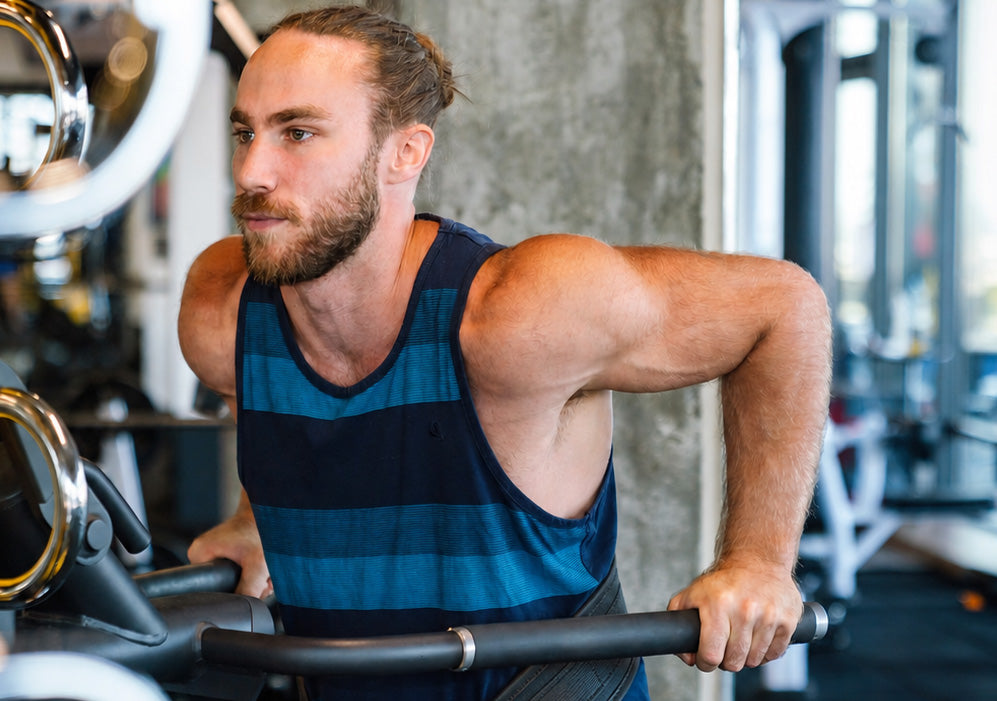
Few moves build the arms like the weighted dip, a compound movement that hammers the triceps under a heavy load while also recruiting the chest and shoulders. Like the close-grip bench, its value lies in how much weight you can progressively add: strap on a belt, add plates over the weeks, and you have a powerful driver of triceps mass. Keep a slight forward lean for chest involvement or stay more upright to bias the triceps, and lower until you feel a genuine stretch. If bodyweight dips are easy, adding load turns this into one of the most effective arm builders available.
5. Chin-Ups
The chin-up is the biceps equivalent of the dip: a compound pull that lets you load the biceps far more heavily than any curl by using your entire bodyweight and then some. With an underhand, shoulder-width grip, the biceps are heavily involved in pulling your chin over the bar, and once you can do these for reps, adding weight via a belt creates the progressive overload that grows them [1]. Beyond the arm-building payoff, chin-ups build a stronger back and grip at the same time. This is how you make the biceps work against real, progressable resistance instead of a light dumbbell.
How Should You Program These Moves for Growth?
Five great moves are only as good as the way you apply them. Distribute these across your training week alongside your other upper-body work, aiming for enough weekly volume to challenge both the biceps and triceps, since total weekly volume is one of the strongest levers for hypertrophy [3]. Most lifters grow well with roughly ten or more hard sets per muscle per week, built up sensibly over time. Do not use the same weight forever: the entire point of choosing loadable moves like the close-grip bench, dips, and chin-ups is that you can add weight or reps week over week. That progression is what separates arms that grow from arms that stall.
Train each move through a full range of motion, control the lowering phase, and push your working sets close to failure while keeping your form intact. Then let progressive overload do its work over the weeks.
What Should You Take Before Arm Day?
Demanding arm sessions built on heavy compounds deserve real fuel, and this is where the right support turns a decent session into a productive one.
For full arm-focused sessions, Nitraflex Advanced delivers the energy and focus to attack heavy close-grip presses, dips, and chin-ups with genuine intensity rather than dragging through them. The ISSN position stand on caffeine confirms that pre-workout supplements containing caffeine enhance both anaerobic and aerobic performance at doses of 3 to 6 milligrams per kilogram of body mass [4], which is exactly the kind of output arm day demands. On busier days, or when you are training on the go, Nitraflex Chews bring that same focused pre-workout support in a no-mix, portable format so you never skip the prep.
To support the growth itself, few tools are better established than creatine. A meta-analysis found that creatine supplementation combined with resistance training promotes greater muscle hypertrophy in both the upper and lower body compared to training alone [5]. Creatine Monohydrate is the form the research is built on, working through daily saturation, so take a consistent daily dose and never skip it. Over weeks of progressive arm work, that daily habit helps you push the volume and load that build bigger arms.

Build Arms That Actually Grow
The curl rack is not the enemy, but it is not the whole answer either. Bigger arms come from training both the biceps and triceps through a full range of motion, loading them with progressable compound moves, accumulating enough weekly volume, and fueling the work properly. Trade a few of those endless light curls for close-grip presses, overhead extensions, incline curls, weighted dips, and chin-ups, and give the triceps the attention they deserve as the larger half of your arm.
Add these five moves to your next upper-body day and progress the load weekly. Compete harder, and build arms that actually grow, with GAT Sport at gatsport.com.
Key Takeaways
- Bigger arms come from training biceps and triceps through a full range of motion with progressive load, not endless light curls.
- The triceps make up roughly two-thirds of the upper arm, so prioritizing them drives the most visible size.
- The five best moves are the close-grip bench press, overhead triceps extension, incline dumbbell curl, weighted dips, and chin-ups.
- Aim for roughly ten or more hard sets per week for each muscle and add weight or reps over time.
- Fuel heavy sessions with a focused pre-workout and support growth with consistent daily creatine.
Frequently Asked Questions
What are the best exercises for bigger arms?
The best arm exercises train both the biceps and triceps through a full range of motion with progressive load. Five of the most effective are the close-grip bench press, overhead triceps extension, incline dumbbell curl, weighted dips, and chin-ups. These loadable moves let you add weight over time, which drives the progressive overload that grows muscle, and they train the triceps hard, which matters because the triceps make up roughly two-thirds of your upper arm.
Are curls enough to build big arms?
Not on their own. Curls train only the biceps, which are the smaller portion of the upper arm, and doing the same light curls without progression leads to stalled growth. Bigger arms require loading the triceps hard through moves like close-grip presses, dips, and overhead extensions, and applying progressive overload across all your arm work rather than repeating the same weight.
How many sets per week should I do for arms?
Most lifters grow well with roughly ten or more hard sets per week for each of the biceps and triceps, built up sensibly over time. Total weekly volume is one of the strongest drivers of muscle growth, so distributing quality sets across your training week, with progression in load or reps, matters more than any single session.
Do the triceps or biceps matter more for arm size?
The triceps matter more for overall arm size because they make up roughly two-thirds of the upper arm. Most lifters overtrain the biceps and undertrain the triceps, which limits growth. Prioritizing heavy, full-range triceps work through pressing and extension movements is one of the fastest ways to add visible arm size.
Does creatine help build bigger arms?
Creatine supports arm growth indirectly by improving your capacity for high-intensity training, which lets you perform more quality volume over time. A meta-analysis found that creatine combined with resistance training produces greater muscle hypertrophy in both the upper and lower body than training alone. It works through daily saturation, so consistency matters more than timing.
References
- Schoenfeld, Brad J., et al. "Strength and Hypertrophy Adaptations Between Low- Versus High-Load Resistance Training: A Systematic Review and Meta-Analysis." Journal of Strength and Conditioning Research, vol. 31, no. 12, 2017, pp. 3508-3523, doi:10.1519/JSC.0000000000002200.
- Wolf, Milo, et al. "Partial vs Full Range of Motion Resistance Training: A Systematic Review and Meta-Analysis." International Journal of Strength and Conditioning, vol. 3, no. 1, 2023, doi:10.47206/ijsc.v3i1.182.
- Schoenfeld, Brad J., et al. "Calculating Set-Volume for the Limb Muscles with the Performance of Multi-Joint Exercises: Implications for Resistance Training Prescription." Sports, vol. 7, no. 7, 2019, article 177, doi:10.3390/sports7070177.
- Guest, Nanci S., et al. "International Society of Sports Nutrition Position Stand: Caffeine and Exercise Performance." Journal of the International Society of Sports Nutrition, vol. 18, no. 1, 2021, article 1, doi:10.1186/s12970-020-00383-4.
- Burke, Ryan, et al. "The Effects of Creatine Supplementation Combined with Resistance Training on Regional Measures of Muscle Hypertrophy: A Systematic Review with Meta-Analysis." Nutrients, vol. 15, no. 9, 2023, article 2116, doi:10.3390/nu15092116.