
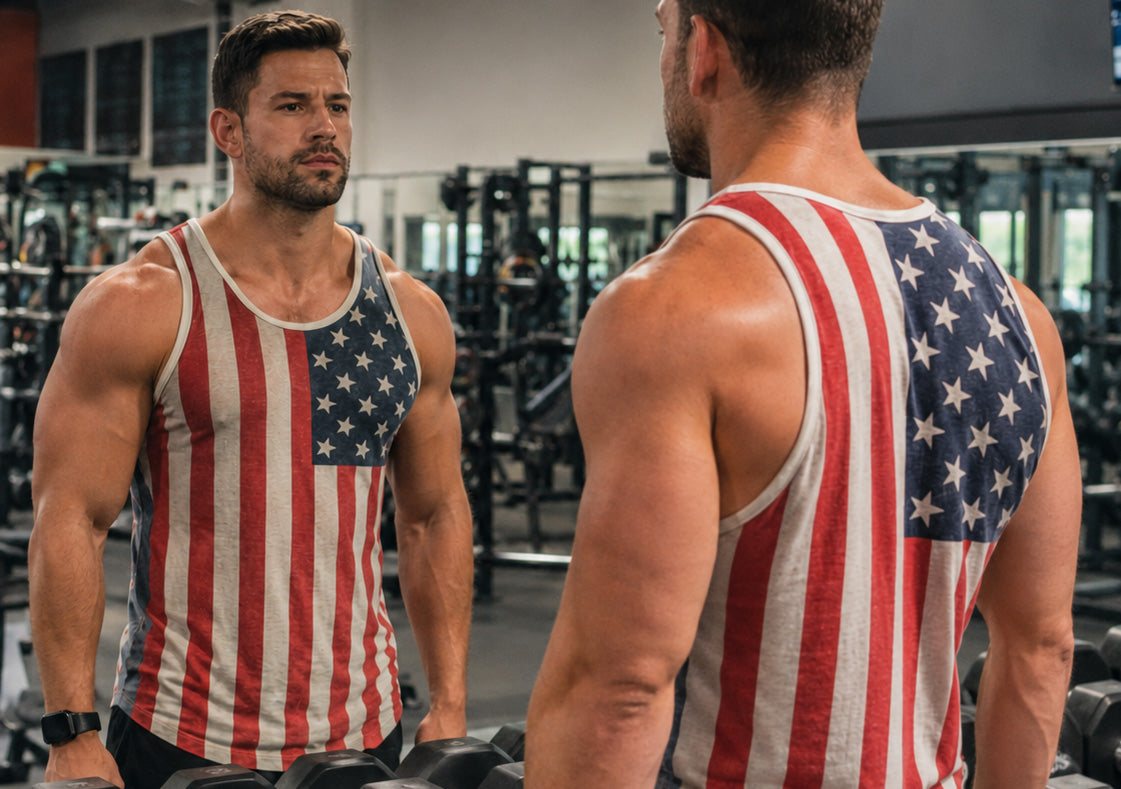
The country turns 250 today, so declare a little independence of your own. The first thing on the chopping block? The gas-station energy drink rattling around your gym bag.
We all carry training dependencies. They feel like rituals, but a lot of them are just habits quietly capping your results. Some live in your gym bag, some live in your head, and some live in the endless scroll of programs you keep starting and abandoning. The good news about a dependency is that it can be broken. Here are five worth declaring independence from this summer, starting with the one most lifters reach for before they even touch a barbell.
1. The Sugary Energy Drink as a Pre-Workout
Are energy drinks a good pre-workout? Not really. Most high-sugar energy drinks pair a big stimulant hit with a pile of sugar and very little that actually supports training performance. You get the jolt, then the crash, and almost none of the studied ingredients that move the needle in a real pre-workout.
The difference comes down to what is inside. A properly dosed pre-workout delivers ingredients with actual evidence behind them. The ISSN position stand on caffeine confirms that pre-workout supplements containing caffeine enhance both anaerobic and aerobic performance, with caffeine reliably improving output at doses of 3 to 6 milligrams per kilogram of body mass [1]. The position stand also notes that energy gels and chews are effective delivery formats for performance caffeine [1]. Beyond the stimulant, ingredients like L-citrulline have been shown across multiple trials to reduce perceived exertion and muscle soreness [2] while supporting training volume and performance [3], and beta-alanine, taken consistently, raises muscle carnosine to buffer fatigue during hard efforts [4].
This is exactly where Nitraflex Chews earn a permanent spot in the bag. They give you a measured caffeine dose plus performance ingredients in a chewable format with no shaker, no mixing, and no sugar crash. You get the studied benefits without the gas-station compromise, and you can take them anywhere.
The dependency: waiting to feel motivated before you train. If the fire is not there, the session does not happen. This is one of the most common reasons summer progress stalls, because motivation is weather-dependent, mood-dependent, and completely unreliable in July heat.
The lifters who make progress year-round are not more motivated than you. They have simply stopped depending on motivation at all. The research on behavior change backs this up: interventions that build exercise into an automatic, cue-triggered habit produce measurable improvements in how consistently people stay active, working through a different pathway than fragile intention and motivation [5]. Discipline built into a system is a renewable resource. Motivation is a lucky bonus. Break the dependency by training at a set time tied to a consistent daily cue, regardless of how you feel walking in, and let the habit do the heavy lifting.
The dependency: chasing the next perfect program before the current one has had time to work. A new split shows up in your feed, it promises faster results, and you jump ship in week three, again. The constant restarting feels productive, but it guarantees you never stay on anything long enough to actually adapt to it.
Progress in the gym is built on progressive overload applied consistently over time. A large network meta-analysis of resistance training found that systematically progressing load and volume drives measurable gains in both strength and muscle size, and that strength improves across a wide range of training configurations as long as the work is hard and progressed [6]. Almost any reasonable program works if you run it long enough to add weight and reps across the weeks. Constantly switching resets that progression to zero every time. Pick a sound program, commit to a real block of eight to twelve weeks, and measure your progress by what the bar is doing, not by how novel the routine feels.
4. Endless Cardio for Fat Loss
The dependency: treating the treadmill as the only path to a leaner summer physique. When the goal is fat loss, the instinct is to add more and more cardio until your training week is mostly running and almost no lifting. The problem is that hours of cardio do little to protect the muscle that gives your body shape, and it eats into the recovery your lifting needs.
Fat loss is driven primarily by your energy balance, the relationship between the calories you take in and the calories you burn, not by cardio volume specifically [7]. A moderate calorie deficit paired with continued resistance training does the real work of leaning out while holding onto muscle. Cardio is a useful tool for nudging the deficit and supporting heart health, but it is a supporting actor, not the lead. Break the dependency by keeping the iron central to your week and letting cardio play a measured, complementary role.
The dependency: needing more and more stimulant just to feel normal in the gym. It starts with one scoop, then two, then a pre-workout plus a coffee plus an energy drink, all stacked on top of each other. Tolerance climbs, sleep suffers, and eventually you are taking a huge stimulant load just to reach a baseline you used to hit on far less.
This matters on two fronts. First, controlled studies show that daily caffeine habituation can blunt its performance benefit over weeks of consecutive use, so an ever-escalating stack delivers diminishing returns rather than bigger ones [8]. Second, the sleep you sacrifice to late stimulants carries a real cost: a meta-analysis of acute sleep loss found meaningful impairments in physical performance, including strength and power [9]. The fix is to respect the dose and protect your sleep. For full training sessions where you want a complete performance profile, Nitraflex Advanced delivers a structured formula built for the job, so you are getting a deliberate dose rather than randomly stacking sources. Use stimulants as a tool with a ceiling, not a habit with no brakes, and consider periodic lower-stim stretches to reset your tolerance.
Five dependencies, five chances to take back a little control over your training. You do not have to break all of them at once. In fact, trying to overhaul everything in one week is its own kind of all-or-nothing trap. Pick one. Swap the energy drink, commit to a program, or rein in the stimulants. Just choose the one that is costing you the most and start there.
This Independence Day, pick one dependency to break this week and tell us which one in the comments. Then go compete harder, all summer long, with GAT Sport at gatsport.com.
-
Guest, Nanci S., et al. "International Society of Sports Nutrition Position Stand: Caffeine and Exercise Performance." Journal of the International Society of Sports Nutrition, vol. 18, no. 1, 2021, article 1, doi:10.1186/s12970-020-00383-4.
-
Rhim, Hye Chang, et al. "Effect of Citrulline on Post-Exercise Rating of Perceived Exertion, Muscle Soreness, and Blood Lactate Levels: A Systematic Review and Meta-Analysis." Journal of Sport and Health Science, vol. 9, no. 6, 2020, pp. 553-561, doi:10.1016/j.jshs.2020.02.003.
-
Trexler, Eric T., et al. "Acute Effects of Citrulline Supplementation on High-Intensity Strength and Power Performance: A Systematic Review and Meta-Analysis." Sports Medicine, vol. 49, no. 5, 2019, pp. 707-718, doi:10.1007/s40279-019-01091-z.
-
Trexler, Eric T., et al. "International Society of Sports Nutrition Position Stand: Beta-Alanine." Journal of the International Society of Sports Nutrition, vol. 12, no. 30, 2015, doi:10.1186/s12970-015-0090-y.
-
Feng, Yiyang, et al. "Effects of Habit Formation Interventions on Physical Activity Habit Strength: Meta-Analysis and Meta-Regression." International Journal of Behavioral Nutrition and Physical Activity, vol. 20, no. 1, 2023, article 109, doi:10.1186/s12966-023-01493-3.
-
Currier, Brad S., et al. "Resistance Training Prescription for Muscle Strength and Hypertrophy in Healthy Adults: A Systematic Review and Bayesian Network Meta-Analysis." British Journal of Sports Medicine, vol. 57, no. 18, 2023, pp. 1211-1220, doi:10.1136/bjsports-2023-106807.
-
Hall, Kevin D., and Juen Guo. "Obesity Energetics: Body Weight Regulation and the Effects of Diet Composition." Gastroenterology, vol. 152, no. 7, 2017, pp. 1718-1727, doi:10.1053/j.gastro.2017.01.052.
-
Pickering, Craig, and Jozo Grgic. "Caffeine and Exercise: What Next?" Sports Medicine, vol. 49, no. 7, 2019, pp. 1007-1030, doi:10.1007/s40279-019-01101-0.
-
Craven, Jonathan, et al. "Effects of Acute Sleep Loss on Physical Performance: A Systematic and Meta-Analytical Review." Sports Medicine, vol. 52, no. 11, 2022, pp. 2669-2690, doi:10.1007/s40279-022-01706-y.