

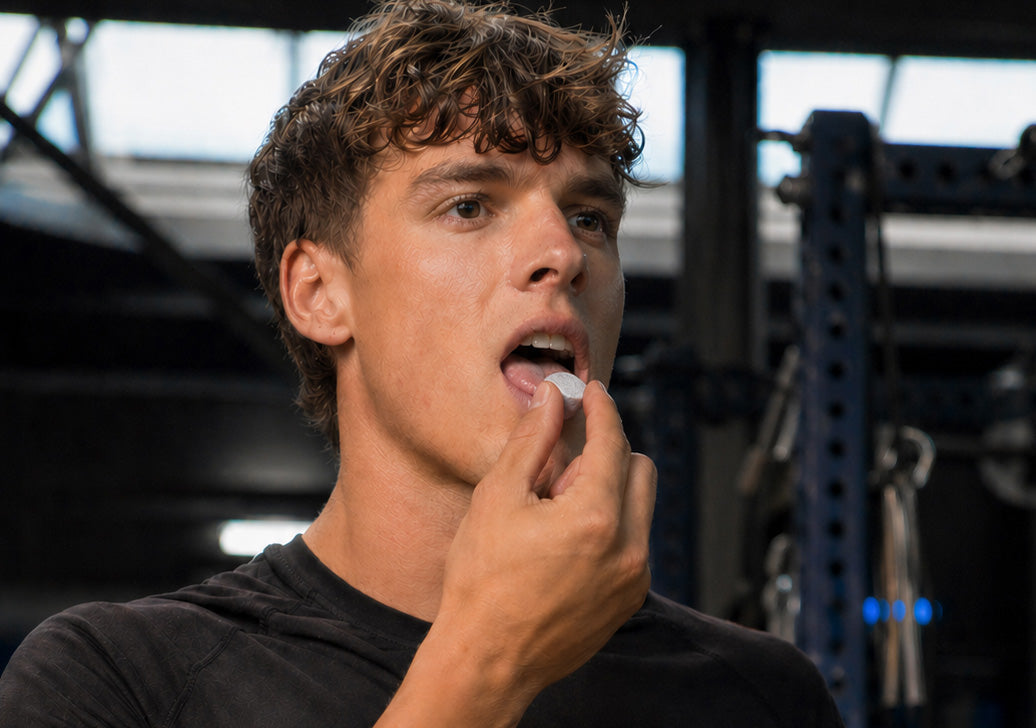
Nobody quits energy drinks because of a lecture. They quit when something works better and fits in a pocket. That is the quiet shift happening in gym bags everywhere right now, and it has nothing to do with guilt and everything to do with what actually performs when your schedule is packed and your training window is tight.
The problem is familiar. Powders need a shaker and water, which is one more thing to carry, mix, and clean. Energy drinks are mostly sugar wrapped in marketing, delivering a jolt and a crash but little that supports a hard session. Caught between the two, busy lifters end up under-fueled and dragging into training. A chewable pre-workout solves that squeeze, and here are six reasons lifters are making the switch.
Are Chewable Pre-Workouts as Good as Powder?
Yes. A chewable pre-workout can deliver the same evidence-based ingredients that make a powder effective, including a measured caffeine dose and performance ingredients, just in a no-mix, portable format. The delivery form is different; the job it does is the same. What you gain is convenience and dosing control without giving up the performance support.

Here are the six reasons the switch is happening.
1. Real Ingredients, Not Just Sugar and Stimulants
The biggest reason lifters leave energy drinks behind is that a proper pre-workout actually contains what supports training. The ISSN position stand on caffeine confirms that pre-workout supplements containing caffeine enhance both anaerobic and aerobic performance, with reliable benefits at doses of 3 to 6 milligrams per kilogram of body mass [1]. Beyond caffeine, L-citrulline has been shown in a meta-analysis to produce a small but significant benefit to strength and power performance [2], and beta-alanine, taken consistently, raises muscle carnosine to buffer the fatigue that builds during hard sets [3]. Nitraflex Chews bring those studied ingredients to the table. An energy drink mostly brings sugar.
2. No Shaker, No Water, No Cleanup
The practical friction of powder is real. You need a shaker bottle, you need water, and afterward you need to clean a bottle that turns rank if you forget it in your bag. For a lifter squeezing a session between work and everything else, that friction is often the difference between taking a pre-workout and skipping it. Chews remove every step of it. You pull them out, you chew, you train. That simplicity is not a gimmick; it is what keeps your pre-workout routine consistent when life gets busy, and consistency is what drives results.
3. They Go Wherever You Train
Summer training rarely happens in one place. You might be at the gym one day, a park the next, a hotel the day after. A tub of powder does not travel well, and a shaker full of liquid is a spill waiting to happen in your bag. Chews are pocket-sized and travel-ready, so your pre-workout is always with you whether you are training at home, on the road, or outdoors. The best pre-workout is the one you actually have with you when it is time to train, and a portable format wins that contest every time.
4. You Can Pace Your Caffeine Instead of Slamming It
This is an advantage most lifters do not think about until they feel it. When you slam an energy drink or a scooped pre-workout, you commit to the entire caffeine dose at once. With chews, you control the intake piece by piece. Research on caffeine confirms that the ergogenic benefits appear reliably in the 3 to 6 milligram per kilogram range, and that individual tolerance to caffeine varies considerably [1]. A chewable format lets you take what you need for the session in front of you, pacing your dose to match the workout and your own sensitivity rather than being locked into a single fixed hit. That control is especially useful on lighter days or when you train later and want to manage your total stimulant load.
5. Lower Sugar Than the Gas-Station Option
Energy drinks solve the energy problem the wrong way, leaning on large amounts of sugar for a fast spike that is usually followed by a crash mid-session. That sugar adds calories that work directly against a summer cut and does nothing to support your actual training. Nitraflex Chews are built as a low-sugar option focused on performance ingredients rather than a sugar rush. You get the pre-workout support you are after without the sugar load or the calories that quietly undermine your goals.
6. They Cover the Same Job as Your Powder
Switching to chews does not mean downgrading. Nitraflex Chews are designed to cover the same core pre-workout role as a scoop of Nitraflex Advanced, delivering performance-focused ingredients to prime you for a hard session. The two are teammates, not rivals. Many lifters keep Nitraflex Advanced for full sessions at home, where mixing a powder is no obstacle and they want the complete powder experience, and reach for Nitraflex Chews on busy or on-the-go days when convenience matters most. You are not choosing an inferior option; you are choosing the right tool for the day in front of you.
The Real Reason the Switch Sticks
Notice what ties these six reasons together: none of them ask you to sacrifice performance for convenience. That is why the switch sticks. Lifters do not abandon energy drinks out of willpower; they move on because a chewable pre-workout delivers real, studied ingredients in a format that fits an actual life. It removes the friction that causes skipped sessions, it travels anywhere, and it gives you control over your dose that a can of sugar never could.
Energy drinks were never built for training. They were built for a quick hit and a marketing moment. A dedicated pre-workout, in a format you will actually use consistently, is simply the better tool for a lifter who takes training seriously.
See the six reasons, then try Chews before your next on-the-go session. Compete harder wherever training takes you this summer, with GAT Sport at gatsport.com.
References
- Guest, Nanci S., et al. "International Society of Sports Nutrition Position Stand: Caffeine and Exercise Performance." Journal of the International Society of Sports Nutrition, vol. 18, no. 1, 2021, article 1, doi:10.1186/s12970-020-00383-4.
- Trexler, Eric T., et al. "Acute Effects of Citrulline Supplementation on High-Intensity Strength and Power Performance: A Systematic Review and Meta-Analysis." Sports Medicine, vol. 49, no. 5, 2019, pp. 707-718, doi:10.1007/s40279-019-01091-z.
- Trexler, Eric T., et al. "International Society of Sports Nutrition Position Stand: Beta-Alanine." Journal of the International Society of Sports Nutrition, vol. 12, no. 30, 2015, doi:10.1186/s12970-015-0090-y.