

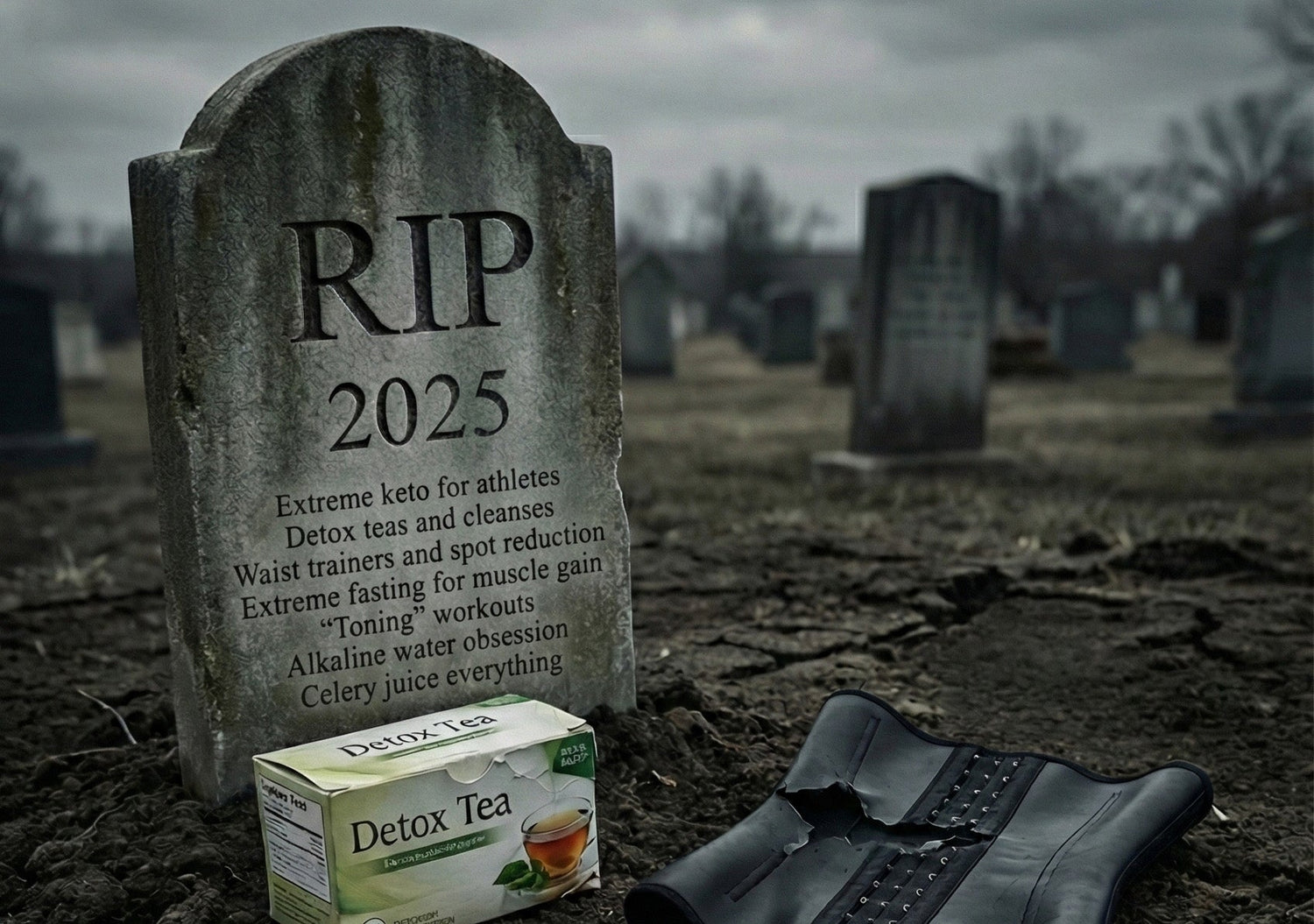
Every January, the fitness industry serves up a fresh batch of miracle solutions. Spoiler alert: most of them belong in the same dumpster as your 2019 juice cleanse. Let's autopsy the biggest flops and discover what actually moves the needle in 2026.
Resolution fatigue has reached epidemic proportions. Over 80% of New Year's goals fail by February, driven by information overload and fad diets that promise quick fixes but deliver metabolic damage (1). These extreme approaches trigger adaptive thermogenesis, slowing your metabolism while accelerating muscle loss, making regain not just likely but inevitable (2). Meanwhile, something as simple as proper protein timing can maintain muscle protein synthesis and prevent these pitfalls entirely (3).
The cycle is predictable: January enthusiasm meets February reality. By March, the gym regulars reclaim their equipment from the resolution crowd, who've already moved on to the next quick fix. The tragedy isn't just wasted money on unused memberships and abandoned supplements. It's the metabolic damage, the psychological defeat, and the reinforced belief that transformation is impossible. But transformation isn't impossible; it's just incompatible with the nonsense peddled every January.
Why Extremes Always Fail
Metabolic adaptation kicks in within weeks of severe restriction, reducing your daily energy expenditure by 200 to 500 calories (2). Your body literally fights back against extreme approaches by becoming more efficient at storing fat and burning fewer calories. This isn't a design flaw; it's evolutionary brilliance that kept our ancestors alive during famines. But in modern society, where the famine never comes and the diet always breaks, this adaptation becomes the reason your metabolism feels "broken" after years of yo-yo dieting.
Meanwhile, research on protein timing shows that distributing 20 to 40g per meal maximizes muscle protein synthesis, supporting sustainable change without triggering survival mechanisms (3). This approach works because it aligns with your body's natural processes rather than declaring war on them. Yet every January, millions ignore this simple science in favor of whatever Dr. Oz is selling this week.
Now for the countdown of 2025's most spectacular failures:
7. Celery Juice Everything
The Claim: Celery juice burns fat, detoxes your system, and cures everything from acne to anxiety. Influencers wake at 5 AM to drink 16 ounces on an empty stomach, claiming it's nature's medicine.
The Flop: Zero evidence exists for special fat-burning properties. It's mostly water with negligible calories and minimal nutrients (4). Any "detox" effect is pure placebo, since your liver handles detoxification perfectly without vegetable assistance (5). The green color doesn't make it magical. The morning ritual doesn't activate hidden healing powers. It's literally just expensive vegetable water that makes you feel virtuous while providing less nutrition than a basic multivitamin.
The Lesson: Hydration matters, but not from overpriced green water marketed as medicine. You'd get more benefits from eating actual celery with hummus, which at least provides fiber and protein. The real magic isn't in the juice; it's in the morning routine and hydration that could be achieved with regular water and a consistent wake time.
6. Alkaline Water Obsession
The Claim: Alkaline water balances your body's pH for better health and accelerated weight loss. Bottles costing $4 each promise to neutralize your "acidic lifestyle" and unlock metabolic potential.
The Flop: Your body regulates blood pH between 7.35 and 7.45 regardless of what you drink. This regulation is so critical that even minor deviations would land you in the ICU. Alkaline water neutralizes instantly in stomach acid, which needs to be acidic to digest food properly, with zero systemic impact (6). Studies show absolutely no performance or health benefits beyond regular hydration (7). You're literally paying extra for water that becomes regular water the moment it hits your stomach.
The Lesson: Focus on your overall diet for health, not magic water. Your kidneys and lungs manage pH balance better than any bottled water ever could. Save your money for actual nutrition or supplements with proven benefits. If you're concerned about acidity, eat more vegetables, which actually do provide alkaline minerals along with fiber, vitamins, and phytonutrients.
5. "Toning" Workouts
The Claim: High-rep, light-weight routines "tone" muscles without adding bulk. Pink dumbbells and endless repetitions promise long, lean muscles like a dancer.
The Flop: "Toning" is a complete myth perpetuated by fitness magazines targeting people afraid of weights. Visible muscle definition requires actual muscle growth combined with fat loss. No special rep range creates magical "tone" (8). High reps don't selectively sculpt anything or create "longer" muscles, since muscle length is determined by your skeleton (9). Those "toned" fitness models you admire? They lift heavy weights and control their diet. The "toning" workouts they demonstrate in magazines? Marketing theater.
The Lesson: Build muscle to reveal it. Stop fearing weights. Your muscles know tension and adaptation, not the color of your dumbbells or the marketing label on your workout. Progressive overload with challenging weights builds the muscle that creates shape. Diet reveals what you've built. There's no shortcuts, no special "toning zone," and definitely no reason to waste months with 2-pound weights.
4. Extreme Fasting for Muscle Gain
The Claim: Extended fasts boost growth hormone for superior gains. The longer you fast, the more anabolic you become. Some protocols suggest 48-72 hour fasts for "maximum hormone optimization."
The Flop: Extended fasting impairs muscle protein synthesis by missing critical anabolic windows. Protein synthesis drops to near zero without regular amino acid intake (10). While growth hormone does increase during fasting, it's to preserve muscle during starvation, not build it. You can't build a house without materials, and you can't build muscle without amino acids. Building muscle requires consistent feeding, not starvation (11). The irony is that the people promoting extreme fasting for gains usually built their physiques with consistent eating and training, not starvation protocols.
The Lesson: Time nutrients around training, don't eliminate them entirely. The anabolic window might be wider than the old "30 minutes post-workout" myth, but it's not infinite. Regular protein feedings every 3-5 hours optimize muscle protein synthesis. Save extended fasting for spiritual practices or specific medical protocols, not muscle building.
3. Waist Trainers and Spot Reduction
The Claim: Compression trainers or targeted exercises melt belly fat specifically. Wear this modern corset, do these special ab exercises, and watch your waist shrink while everything else stays the same.
The Flop: Spot reduction is physiologically impossible. Fat loss occurs systemically based on genetics and hormones, with zero local effect from exercises or devices (12). Your body decides where to pull fat from based on genetics, gender, and hormonal status, not where you squeeze yourself or how many crunches you do. Waist trainers cause temporary compression that disappears within hours, not actual fat loss (13). They can actually weaken your core by doing the stabilization work your muscles should be doing.
The Lesson: Overall caloric deficit drives reduction everywhere, not compression garments. Want to lose belly fat? Create a consistent deficit through diet and training. Want a stronger core? Do compound movements that challenge stability. Want to waste money? Buy a waist trainer and wonder why your organs hurt after wearing a corset to the gym.
2. Detox Teas and Cleanses
The Claim: Special teas flush toxins for rapid, healthy weight loss. Celebrities swear by these magical blends that promise to reset your metabolism and eliminate years of accumulated "toxins."
The Flop: No scientific support exists for detox claims. These products are essentially laxatives causing water loss and bathroom emergencies, not toxin removal (14). Your liver detoxes naturally without tea, processing everything from alcohol to metabolic waste products 24/7. Many of these products risk actual liver damage from undisclosed ingredients and excessive senna (15). The weight you lose? Water and feces. The weight you gain back immediately after? Everything you lost plus stress eating from the miserable experience.
The Lesson: Choose sustainable habits over Instagram scams. Your liver and kidneys are the only detox system you need, and they work best when supported with adequate hydration, balanced nutrition, and moderate alcohol intake. Skip the theatrical cleanse and focus on consistent, boring habits that actually work.
1. Extreme Keto for Athletes
The Claim: Keto transforms everyone into fat-burning machines for peak athletic performance. Carbs are poison, fat is fuel, and ketones are superior to glucose for everything.
The Flop: Ketogenic diets deplete glycogen stores, impairing high-intensity efforts consistently. Studies show 10 to 15% performance decline in athletes requiring explosive power (16). The diet fails catastrophically for sports requiring repeated bursts of intensity (17). While some endurance athletes can adapt to fat-burning for steady-state efforts, anyone needing to sprint, jump, or lift heavy will suffer. The "keto flu" isn't adaptation; it's your body screaming for the primary fuel it evolved to use for intense efforts.
The Lesson: Carbs fuel intensity. Fat adaptation can't replace glycogen for power. Use the right fuel for the right activity. Keto might work for sedentary weight loss or ultra-endurance events, but if your sport involves a clock, a barbell, or opponents, you need carbohydrates.
What Actually Works in 2026: Evidence-Based Fundamentals
Ditch the fads for proven principles that have worked since humans started lifting heavy things. Progressive overload through gradual intensity increases drives real hypertrophy (18). This means adding weight, reps, or sets systematically, not randomly changing exercises every workout because muscle confusion is another myth.
Adequate protein at 1.6 to 2.2g per kilogram daily maximizes muscle protein synthesis (19). This isn't excessive or kidney-destroying; it's optimal for anyone training seriously. Spread it throughout the day rather than cramming it into one meal or avoiding it entirely during fasting windows.
Quality sleep of 7 to 9 hours nightly regulates hormones better than any supplement (20). This is when growth hormone peaks naturally, testosterone rebuilds, and cortisol resets. All the supplements in the world can't overcome chronic sleep deprivation.
Strategic supplementation with proven compounds delivers measurable results when basics are covered. Not magic pills, but tools that enhance what you're already doing right.

Spotlight: GAT Sport's Proven Lineup
Creatine Chews deliver what 30+ years of research proves: 5 to 15% strength gains that actually last (21). Now available in convenient, zero-sugar chews that ensure perfect compliance. No mixing, no grit, no excuses. Just consistent supplementation with the most researched performance supplement in history.
FLEXX EAAs + Hydration supports muscle protein synthesis without extreme protocols. The leucine content drives 20 to 50% better synthesis than standard protein alone (22). Perfect for training days when whole food isn't practical or recovery days when you need aminos without calories. This loaded new formula includes essential key electrolytes to keep you hydrated to perform at your best day after day.
Nitraflex Sport provides clean energy without crashes. Beta-alanine buffers fatigue for sustained training sessions when willpower alone fails (23). This isn't about feeling wired; it's about maintaining intensity through entire workouts.
Build on these proven tools for lasting change instead of chasing the next celery juice miracle.
Bottom Line: Physics Beats Fads
Fads flop because they fight physiology. Fundamentals win because they work with it. Your body follows predictable laws of thermodynamics and protein synthesis, not Instagram influencer promises. The sooner you accept this; the sooner you'll see real results.
The fitness industry will continue selling shortcuts because desperation outsells discipline. But you don't have to buy what they're selling. The basics that built physiques in the 1970s still build them today. The fundamentals that created athletes before social media still create them now. The difference is we have better research confirming what works and better tools to optimize the process.
References
- Norcross, John C., et al. (2002). Auld Lang Syne: Success Predictors, Change Processes, and Self-Reported Outcomes of New Year's Resolvers and Nonresolvers. Journal of Clinical Psychology, 58(4), 397-405.
- Trexler, Eric T., et al. (2014). Metabolic Adaptation to Weight Loss: Implications for the Athlete. Journal of the International Society of Sports Nutrition, 11(1), article 7.
- Schoenfeld, Brad J., and Alan Albert Aragon. (2018). How Much Protein Can the Body Use in a Single Meal for Muscle-Building? Implications for Daily Protein Distribution. Journal of the International Society of Sports Nutrition, 15(1), article 10.
- Kooti, Wesam, et al. (2016). The Role of Medicinal Herbs in Treatment of Insulin Resistance in Patients with Diabetes Mellitus: A Systematic Review. Biomolecular Concepts, 7(5-6), 275-90.
- Klein, Autumn V., and Hannah Kiat. (2015). Detox Diets for Toxin Elimination and Weight Management: A Critical Review of the Evidence. Journal of Human Nutrition and Dietetics, 28(6), 675-86.
- Fenton, Tanis R., and Tian Huang. (2016). Systematic Review of the Association between Dietary Acid Load, Alkaline Water and Cancer. BMJ Open, 6(6), article e010438.
- Weidman, Joseph, et al. (2016). Effect of Electrolyzed High-pH Alkaline Water on Blood Viscosity in Healthy Adults. Journal of the International Society of Sports Nutrition, 13(1), article 45.
- Schoenfeld, Brad J. (2010). The Mechanisms of Muscle Hypertrophy and Their Application to Resistance Training: A Systematic Review and Meta-Analysis. Journal of Strength and Conditioning Research, 24(10), 2857-72.
- Vispute, Sachin S., et al. (2011). The Effect of Abdominal Exercise on Abdominal Fat. Journal of Strength and Conditioning Research, 25(9), 2559-64.
- Tinsley, Grant M., et al. (2021). Intermittent Fasting Combined with Resistance Training: Effects on Body Composition, Muscular Performance, and Dietary Intake. Journal of Intermittent Fasting, 1(1), article 100001.
- Burke, Louise M., et al. (2017). Low Carbohydrate, High Fat Diet Impairs Exercise Economy and Negates the Performance Benefit from Intensified Training in Elite Race Walkers. Journal of Physiology, 595(9), 2785-807.
- Schoenfeld, Brad J., et al. (2017). Strength and Hypertrophy Adaptations Between Low- vs. High-Load Resistance Training: A Systematic Review and Meta-Analysis. Journal of Strength and Conditioning Research, 31(12), 3508-23.
- Kreider, Richard B., et al. (2017). International Society of Sports Nutrition Position Stand: Safety and Efficacy of Creatine Supplementation in Exercise, Sport, and Medicine. Journal of the International Society of Sports Nutrition, 14, article 18.
- Navarro, Victor J., et al. (2014). Liver Injury from Herbals and Dietary Supplements in the U.S. Drug-Induced Liver Injury Network. Hepatology, 60(4), 1399-408.
- Klein, Autumn V., and Hannah Kiat. (2015). Detox Diets for Toxin Elimination and Weight Management: A Critical Review of the Evidence. Journal of Human Nutrition and Dietetics, 28(6), 675-86.
- Burke, Louise M., et al. (2017). Low Carbohydrate, High Fat Diet Impairs Exercise Economy and Negates the Performance Benefit from Intensified Training in Elite Race Walkers. Journal of Physiology, 595(9), 2785-807.
- McSwiney, Fionn T., et al. (2018). Keto-Adaptation Enhances Exercise Performance and Body Composition Responses to Training in Endurance Athletes. Metabolism, 81, 25-34.
- Schoenfeld, Brad J., et al. (2017). Strength and Hypertrophy Adaptations Between Low- vs. High-Load Resistance Training: A Systematic Review and Meta-Analysis. Journal of Strength and Conditioning Research, 31(12), 3508-23.
- Jäger, Ralf, et al. (2017). International Society of Sports Nutrition Position Stand: Protein and Exercise. Journal of the International Society of Sports Nutrition, 14, article 20.
- Fullagar, Hugh H. K., et al. (2015). Sleep and Athletic Performance: The Effects of Sleep Loss on Exercise Performance, and Physiological and Cognitive Responses to Exercise. Sports Medicine, 45(2), 161-86.
- Kreider, Richard B., et al. (2017). International Society of Sports Nutrition Position Stand: Safety and Efficacy of Creatine Supplementation in Exercise, Sport, and Medicine. Journal of the International Society of Sports Nutrition, 14, article 18.
- Jackman, Sarah R., et al. (2017). Branched-Chain Amino Acid Ingestion Stimulates Muscle Myofibrillar Protein Synthesis Following Resistance Exercise in Humans. Frontiers in Physiology, 8, article 390.
- Guest, Nanci S., et al. (2021). International Society of Sports Nutrition Position Stand: Caffeine and Exercise Performance. Journal of the International Society of Sports Nutrition, 18(1), article 1.