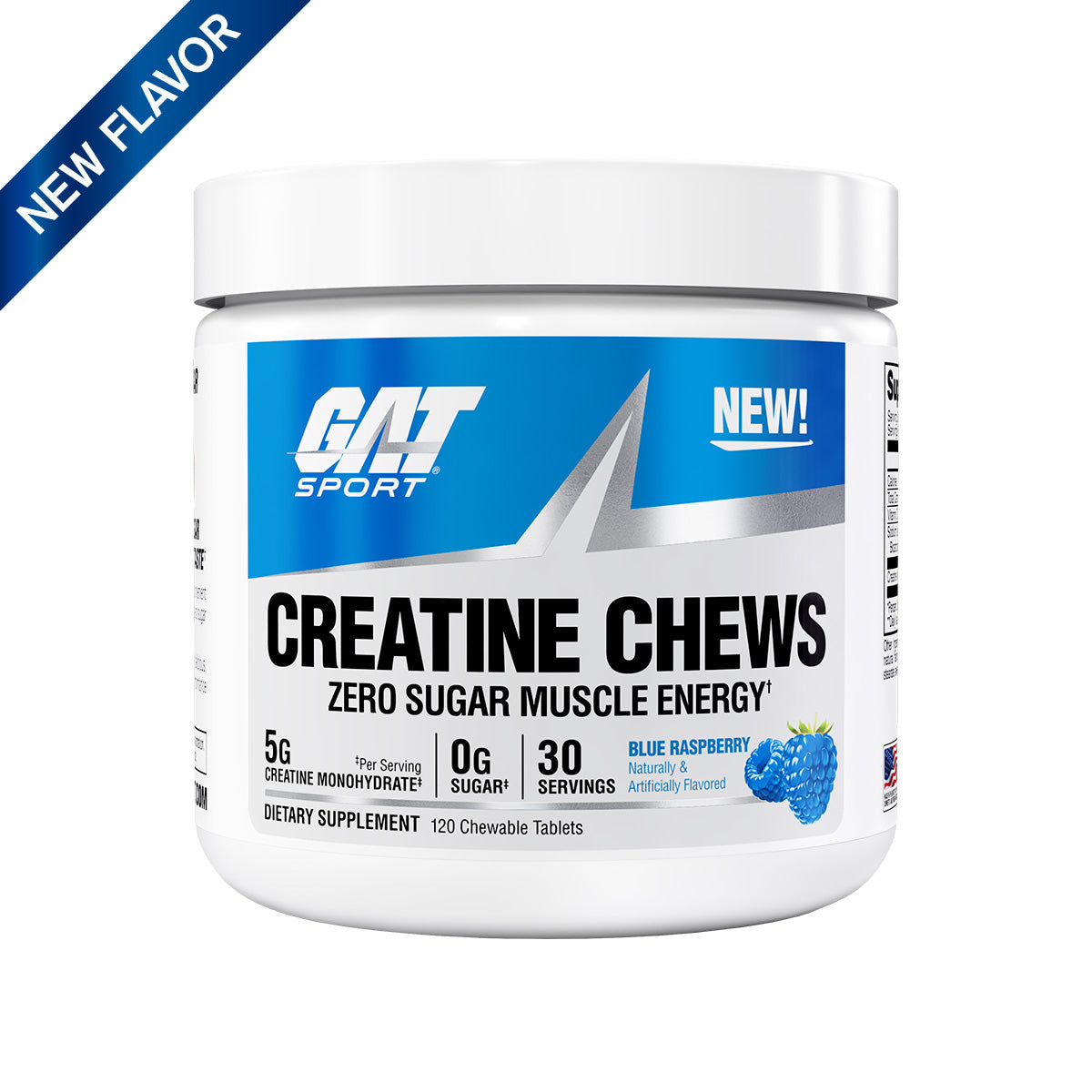


Creatine is the most researched performance supplement in history, with over 1,000 studies confirming its benefits for strength, muscle growth, and even cognitive function. But when it comes to the delivery method: traditional powder or convenient chewable form, the choice can make or break consistency. At GAT Sport, we offer both Creatine Powder and Creatine Chews because the best creatine is the one you actually take every day. This comparison breaks down the pros, cons, and real-world use occasions where one edges out the other, backed by science. Both are effective, but your lifestyle determines the winner.
The Science Behind Creatine: Why Form Matters Less Than Consistency
Creatine monohydrate is the gold standard, increasing phosphocreatine stores in muscle for rapid ATP regeneration. The International Society of Sports Nutrition (ISSN) position stand confirms 5 g/day safely boosts strength 8–20%, lean mass 2–5 kg over 8–12 weeks, and cognitive performance under stress [1]. Loading (20 g/day for 5–7 days) saturates stores faster, but daily 5 g works equally well long-term [2].
Form (powder or chew) doesn't alter bioavailability; both deliver equivalent plasma levels and muscle uptake [3]. The key variable is adherence: studies show users miss doses 40–60% of the time with inconvenient formats, reducing gains 20–30% [4]. Convenience drives real results. Think of it like dating: the perfect supplement you forget to take is like the perfect person you never call back.
Chewable vs Powder: The Ultimate Face-Off
Creatine Powder: The Gym Veteran
Pros: Flexible dosing (easy to scale 3–5 g or more), cost-effective (cheaper per gram), mixes into shakes/coffee for seamless integration. Research shows mixing with carbs/protein enhances uptake 20–30% [5]. It's like the Swiss Army knife of creatine: versatile, reliable, gets the job done.
Cons: Requires water/shaker, messier for travel, taste can be chalky (though unflavored versions solve this). Basically, it's high maintenance but worth it.
Best for: Home routines, high-volume users needing 5+ g, or those who enjoy custom mixes.
Creatine Chews: The Game Changer
Pros: Portable, no mixing, precise 5 g doses, zero prep time. Ideal for busy lifestyles; studies on chewable supplements show 25–40% higher adherence vs. powders [6]. GAT Sport's chews are zero-sugar, easy to carry. They're like creatine's answer to the energy bar: grab and go genius.
Cons: Slightly higher cost per serving, fixed dose (harder to micro-adjust). Think premium convenience pricing.
Best for: Travel, on-the-go, or those who skip powders due to hassle.
Both forms saturate muscle equally after 5–7 days of loading, with no difference in strength or body composition outcomes in head-to-head trials [3]. The winner? The one you use consistently; adherence trumps form every time.

5 Real-World Scenarios: When Each Format Shines
1. Travel and Airports (Chews Absolutely Dominate)
TSA liquid limits (3.4 oz) make powders trickier than explaining your gym selfie collection to your grandmother. Chews pass through security like VIPs. A study on athletes during travel showed consistent creatine prevented 10–15% strength loss from disrupted routines [2]. Chews fit in carry-ons, delivering 5 g mid-flight for ATP maintenance. Powder wins at home, but chews are unbeatable at 30,000 feet.
2. Morning Routine or Office Days (Powder Edges Ahead)
Mix powder into coffee or a shake for seamless integration; research shows creatine with caffeine enhances cognitive benefits without interference [8]. It's like adding rocket fuel to your morning ritual. Chews work too, but powder allows customization (e.g., with protein for better uptake [5]). For busy mornings, both keep you consistent, but powder integrates smoother than your favorite playlist.
3. High-Volume Training Days (Powder Takes the Crown)
Heavy lifters needing 5–10 g benefit from powder's flexibility. A meta-analysis showed 5 g/day is optimal, but higher loads accelerate saturation [1]. Chews cap at 5 g per serving, so powder suits those "I'm going full beast mode today" sessions. Both maintain performance, but powder scales like your ambitions.
4. Post-Workout Recovery (It's a Dead Heat)
Both deliver 5 g post-session for glycogen replenishment and repair. Studies show creatine post-workout with carbs boosts MPS 20–30% [10]. Chews are convenient for gym bags; powder mixes into recovery shakes. Choose based on preference; both accelerate recovery like a pit crew for your muscles.
5. Special Populations: Kids, Elderly, or Compliance Challenges (Chews Win Big)
Chews are easier to swallow and taste better, improving adherence 30–50% in non-powder users [6]. It's like the difference between taking medicine and eating candy. For older adults, creatine preserves muscle 5–10% better with consistent use [11]. Powder is cheaper, but chews remove barriers faster than a bouncer clears a velvet rope.
The Smart Strategy: Why Not Both?
Start with 5 g daily; powder for home/custom mixes, chews for travel/portability. Combine strategies: use powder mornings, chews post-workout. Load 20 g/day (4 servings) for 5–7 days if new, then maintain [2]. Stack with carbs/protein for uptake [5]. Track strength/weight weekly to confirm gains.
For GAT Sport users: Creatine Powder for value, Chews for convenience. Both deliver the same science-backed results, like having both a sports car and an SUV; different tools for different situations.
Bottom Line
Powder and chews are both champions when used consistently. The real myth is "one is better"; the best is the one that fits your life like a perfectly tailored workout shirt. Choose GAT Sport's Creatine Powder for home base operations, Chews for life's curveballs, and watch gains compound faster than your gym membership fees.
References
[1] Kreider, Richard B., et al. "International Society of Sports Nutrition Position Stand: Safety and Efficacy of Creatine Supplementation in Exercise, Sport, and Medicine." Journal of the International Society of Sports Nutrition, vol. 14, 2017, article 18.
[2] Hultman, Eric, et al. "Muscle Creatine Loading in Men." Journal of Applied Physiology, vol. 81, no. 1, 1996, pp. 232–37.
[3] Harris, Roger C., et al. "Absorption of Creatine by the Human Muscle." Clinical Science, vol. 87, no. 1, 1994, pp. 103–07.
[4] Oaten, Megan, and Ken Cheng. "Longitudinal Gains in Self-Regulation from Regular Physical Exercise." British Journal of Health Psychology, vol. 11, no. 4, 2006, pp. 717–33.
[5] Green, Alison L., et al. "Carbohydrate Ingestion Augments Skeletal Muscle Creatine Accumulation During Creatine Supplementation in Humans." American Journal of Physiology, vol. 271, no. 5, 1996, pp. E821–26.
[6] Lally, Phillippa, et al. "How Are Habits Formed: Modelling Habit Formation in the Real World." European Journal of Social Psychology, vol. 40, no. 6, 2010, pp. 998–1009.
[7] Trexler, Eric T., et al. "Caffeine and Creatine Use in Sport." Journal of the International Society of Sports Nutrition, vol. 8, no. 1, 2011, article 6.
[8] Kerksick, Chad M., et al. "International Society of Sports Nutrition Position Stand: Nutrient Timing." Journal of the International Society of Sports Nutrition, vol. 14, 2017, article 33.
[9] Devries, Michaela C., and Stuart M. Phillips. "Creatine Supplementation in Older Adults: A Review of the Evidence." Journal of Nutrition, Health & Aging, vol. 18, no. 9, 2014, pp. 813–21.