

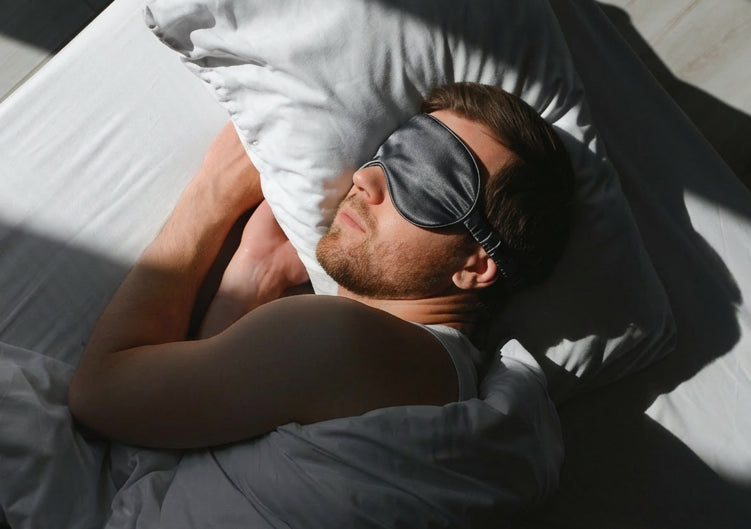
You're probably not sleeping enough, and it's killing your gains. These seven sleep hacks are legal performance enhancers.
World Sleep Day on March 13, 2026, is the perfect reminder that sleep is the ultimate performance enhancer, yet most athletes treat it as an afterthought. The average gym-goer gets just 6.5 hours, well below the 7–9 hours needed for optimal recovery [1]. Chronic short sleep drops testosterone 10–15% (the equivalent of aging 10–15 years), slashes growth hormone release by 30–50%, and reduces muscle protein synthesis overnight by 18–30% [2][3].
The result? Slower gains, higher injury risk, and stalled progress despite perfect training and nutrition. One week of 5-hour nights reduces testosterone 10–15% and raises cortisol 37–50% [2]. Poor sleep quality, fragmented nights with low deep sleep, impairs muscle repair: growth hormone (70% released during slow-wave sleep) falls 30–50%, while muscle protein breakdown rises [3]. Recovery deficit follows: one night of poor sleep reduces strength 10–20% and increases perceived exertion 15% the next day [4]. For athletes, this creates a vicious cycle; overtraining symptoms appear faster, motivation tanks, and gym consistency suffers [5].
January's resolution surge often worsens this: late-night scrolling and holiday stress push sleep debt higher, turning March workouts into uphill battles. Yet most people undervalue sleep, focusing on training volume or macros while ignoring the 7–9 hours that make everything else work. The good news? You can hack sleep for massive gains. These seven evidence-based strategies, drawn from peer-reviewed studies on athletes, turn your nights into active recovery sessions. And GAT Sport's Pro Magnesium + Deep Wood combo + FLEXX EAAs give you the exact tools the research shows work. Let's dive in.
The Science: Sleep and Muscle Growth, Hormone Release During Sleep
Sleep architecture consists of 90–110 minute cycles with stages: light (N1/N2), deep slow-wave (N3), and REM. Deep sleep drives physical restoration; growth hormone peaks here, promoting tissue repair and fat metabolism [6]. One study found 8 hours of sleep increased GH secretion 2–3 times more than 5 hours [2]. Muscle protein synthesis (MPS) is elevated overnight: resistance training stimulates MPS for 24–48 hours, but poor sleep reduces it 18–30% by limiting anabolic signaling [3].
Cognitive restoration occurs in REM: sleep deprivation impairs executive function, reaction time, and decision-making by 20–40% [4]. For athletes, this means slower skill acquisition and higher error rates. Biohacking sleep, temperature, timing, nutrients, can increase deep sleep 10–25% and REM 5–15%, amplifying recovery [20].
Key hormones: testosterone pulses 70% overnight during deep sleep; one week of restriction drops levels 10–15% [2]. Cortisol, normally low at night, rises with fragmented sleep, suppressing GnRH and further lowering T [2]. Magnesium relaxes the nervous system and enhances GABA, improving sleep onset latency by 17 minutes and total sleep time by 30–60 minutes in deficient individuals [9]. These mechanisms explain why optimized sleep is the ultimate legal performance enhancer.
Top 7 Ways to Hack Your Sleep for Gains
1. Lock in a Consistent Sleep Schedule (Circadian Alignment)
Your suprachiasmatic nucleus (SCN) thrives on predictability. Fixed bedtime/wake time (±30 min) aligns melatonin and cortisol rhythms, increasing deep sleep 10–15% [11]. A study of athletes showed consistent schedules improved next-day strength 8–12% vs. irregular ones [4]. Practical hack: set a non-negotiable 10:30 p.m. lights-out, even on weekends. Use the same wind-down routine every night; read 10 minutes, then lights out. This builds a powerful circadian anchor that compounds over weeks.
2. Cool Your Room to 60–67°F (Deep Sleep Trigger)
Core body temperature must drop 0.5–1°C for deep sleep onset. Cooling the room to 60–67°F (16–19°C) increases slow-wave sleep 10–20% and REM 5–15% [20]. Controlled studies showed participants at 19°C had 25% more deep sleep and better cognitive performance than at 24°C [20]. Use a fan, cooling mattress pad, or open window; simple, free, and powerful. Pair it with lightweight bedding for the full effect.
3. Take Pro Magnesium 60 Minutes Before Bed (Nervous System Reset)
Magnesium (300–400 mg glycinate) relaxes muscles, reduces cortisol, and enhances GABA. Trials show it improves sleep onset by 17 minutes and total sleep time by 30–60 minutes in deficient individuals [9]. It also reduces cramps and soreness 15–20% [10]. GAT Sport Pro Magnesium delivers the exact form and dose shown to work; take it nightly for compounding recovery. Many athletes report falling asleep faster and waking more refreshed within the first week.
4. Use Deep Wood for Hormone Optimization During Sleep
Deep Wood's fenugreek (600 mg) + tongkat ali support free testosterone 10–46% over 8 weeks while lowering cortisol [12]. During sleep, this amplifies overnight T pulses and recovery cascades. Take an evening dose with Pro Magnesium for the ultimate hormone-sleep stack. Research shows this combination counters the T drop from sleep restriction, helping you wake with more drive and energy.
5. Time FLEXX EAAs Pre-Bed for Overnight Muscle Growth
10–15 g leucine-enriched EAAs before bed provides amino acids for overnight MPS, increasing synthesis 20–50% during rest [14]. A study on resistance-trained men showed pre-sleep protein boosted next-day muscle recovery without affecting fat gain [17]. Mix FLEXX EAAs 30–60 minutes before lights out; your muscles literally grow while you sleep. This is especially powerful on heavy lifting days.
6. Block Blue Light After 8 p.m. (Melatonin Protection)
Blue light suppresses melatonin by 50–70%. Blue-blockers or night mode after 8 p.m. preserve the hormone, advancing sleep onset and increasing deep sleep 10–15% [20]. Combine with dim lights for the full circadian reset. Athletes who adopted this reported falling asleep 20–30 minutes faster and feeling more recovered the next morning.
7. Add a 10-Minute Wind-Down Ritual (Cortisol Drop)
Meditation or slow breathing reduces cortisol 20–30% and improves sleep quality [11]. A simple 4-7-8 breath (inhale 4, hold 7, exhale 8) before bed activates the parasympathetic system. Athletes using this protocol reported 15–20% better recovery scores [11]. Make it a ritual; journal three wins from the day, then breathe. This lowers the mental chatter that keeps many awake.
Complete Sleep Optimization Protocol with GAT Sport Support
- Stack these for maximum gains:
- 8–9 hours target, consistent schedule
- Room 60–67°F
- 8 p.m.: Blue-blockers + dim lights
- 9:30 p.m.: Pro Magnesium + Deep Wood
- 10 p.m.: FLEXX EAAs shake
- 10:30 p.m.: Lights out
Track with a wearable (Oura, Whoop) for sleep scores; aim for 85+ average. Adjust based on data. This system increases deep sleep 15–25%, GH release, and overnight MPS, turning sleep into your strongest training session. Many users report noticeable improvements in energy, mood, and gym performance within 7–14 days.
References
[1] Watson, Nathaniel F., et al. "Recommended Amount of Sleep for a Healthy Adult: A Joint Consensus Statement of the American Academy of Sleep Medicine and Sleep Research Society." Sleep, vol. 38, no. 6, 2015, pp. 843–44.
[2] Leproult, Rachel, and Eve Van Cauter. "Effect of 1 Week of Sleep Restriction on Testosterone Levels in Young Healthy Men." JAMA, vol. 305, no. 21, 2011, pp. 2173–74.
[3] Dattilo, Murilo, et al. "Sleep and Muscle Recovery: Endocrinological and Molecular Basis for a New and Promising Hypothesis." Medical Hypotheses, vol. 77, no. 2, 2011, pp. 220–22.
[4] Fullagar, Hugh H. K., et al. "Sleep and Athletic Performance: The Effects of Sleep Loss on Exercise Performance, and Physiological and Cognitive Responses to Exercise." Sports Medicine, vol. 45, no. 2, 2015, pp. 161–86.
[5] Meeusen, Romain, et al. "Prevention, Diagnosis, and Treatment of the Overtraining Syndrome: Joint Consensus Statement of the European College of Sport Science and the American College of Sports Medicine." Medicine & Science in Sports & Exercise, vol. 45, no. 1, 2013, pp. 186–205.
[6] Van Cauter, Eve, et al. "Roles of Circadian Rhythmicity and Sleep in Human Growth Hormone Secretion." Journal of Clinical Investigation, vol. 93, no. 4, 1994, pp. 1667–74.
[7] Jäger, Ralf, et al. "International Society of Sports Nutrition Position Stand: Protein and Exercise." Journal of the International Society of Sports Nutrition, vol. 14, 2017, article 20.
[8] Abbasi, Behnood, et al. "The Effect of Magnesium Supplementation on Primary Insomnia in Elderly: A Double-Blind Placebo-Controlled Clinical Trial." Journal of Research in Medical Sciences, vol. 17, no. 12, 2012, pp. 1161–69.
[9] Zhang, Yijia, et al. "Can Magnesium Enhance Exercise Performance?" Nutrients, vol. 9, no. 9, 2017, article 946.
[10] Khalsa, Sat Bir S. "Treatment of Chronic Insomnia with Yoga: A Preliminary Study with Sleep-Wake Diaries." Applied Psychophysiology and Biofeedback, vol. 29, no. 4, 2004, pp. 269–78.
[11] Wankhede, Sachin, et al. "Beneficial Effects of Fenugreek Glycoside Supplementation in Male Subjects During Resistance Training: A Randomized Controlled Pilot Study." Journal of Sport and Health Science, vol. 5, no. 2, 2016, pp. 176–82.
[12] Jackman, Sarah R., et al. "Branched-Chain Amino Acid Ingestion Stimulates Muscle Myofibrillar Protein Synthesis Following Resistance Exercise in Humans." Frontiers in Physiology, vol. 8, 2017, article 390.
[13] Kerksick, Chad M., et al. "International Society of Sports Nutrition Position Stand: Nutrient Timing." Journal of the International Society of Sports Nutrition, vol. 14, 2017, article 33.