


"It makes you puffy." "It's a bulking thing." "That's a guy's supplement."
She has heard all three, probably from people who meant well. A friend at the gym, a comment thread, a trainer a decade out of date. So, the tub of creatine stays on the shelf, and the most researched supplement in sports nutrition keeps getting bought almost entirely by men.
Here is what makes that genuinely strange. The research does not merely say creatine is fine for women. It suggests she may have more to gain from it than he does. Women are the most underserved creatine buyers in the category: the marketing has ignored them for thirty years, the tubs still look like they were designed for a powerlifting forum, and the myths about water weight and bulk have done the rest. Meanwhile the science quietly built a case that creatine deserves a place in a woman's routine at every stage of her training life. Time to read that case out loud.
Should Women Take Creatine?
Yes. Research supports creatine for women who train, with benefits for strength and exercise performance, and, alongside resistance training, support for muscle and bone through and beyond menopause. Women also carry lower creatine stores than men and eat less of it in food, which makes supplementing more relevant, not less. Three to five grams of creatine monohydrate daily is the evidence-backed habit.
Why Her Physiology Makes Creatine More Interesting, Not Less
Creatine is not exotic. Your body makes it, stores most of it in muscle, and uses it to rapidly regenerate ATP, the energy currency behind every hard set, sprint, and rep. Top the stores up, and your muscles can do slightly more high-intensity work, session after session. That is the whole mechanism, and it has nothing to do with sex.
What differs is the starting point. The major review of creatine in women's health reports that females exhibit substantially lower endogenous creatine stores than males, cited at 70 to 80 percent lower, and that women also consume significantly less creatine through diet, largely a function of eating less red meat and fish [1]. The review's conclusion follows naturally: a lower baseline plus lower dietary intake makes supplementation a particularly sensible strategy for women. The same review notes that hormone-related shifts in creatine metabolism across the menstrual cycle, pregnancy, and menopause may make consistent intake even more relevant at specific life stages [1].
None of this means creatine works differently in her body. It means the case for topping up the tank is, if anything, stronger.
What the Research Shows
Strength and Performance, Right Now
For the woman training today, the evidence is straightforward: creatine supplementation in pre-menopausal women appears effective for improving strength and exercise performance [1]. More reps at a given weight, better repeated high-intensity efforts, more quality work per session. Those small margins are exactly what compound into visible progress over a training block.
And her training itself works exactly as well as anyone's. A meta-analysis comparing men and women running the same resistance training programs found no significant difference in muscle hypertrophy and similar lower-body strength gains, while relative upper-body strength gains actually favored women [2]. She is not borrowing a supplement from someone else's sport. She is fueling adaptations her body produces every bit as effectively.
Across the Whole Lifespan
The story does not stop at any particular birthday. Through and after menopause, when declining estrogen accelerates losses in muscle and bone, the review reports that post-menopausal women may see benefits to skeletal muscle size and function with creatine, in the studies showing this, at higher daily doses, and favorable effects on bone when creatine is combined with resistance training [1]. Read that last clause again, because it is the honest version: creatine is not a bone supplement on its own. Paired with progressive strength training, it supports the muscle and bone that training is building, at the stage of life when both need defending most.
Research on creatine, mood, and cognition in women is also emerging, and the review treats it as promising but early [1]. That is exactly how it should be read: worth watching, too soon for promises, and not a reason anyone should buy anything.
The Bloat and Bulk Question, Answered
Now the two myths that have kept the tub on the shelf.
Water weight first. The evidence-based review of creatine misconceptions examined this directly: while creatine draws some water into the muscle cell itself in the short term, particularly with high-dose loading, the research does not support the idea that recommended daily doses cause ongoing water retention or the puffy, bloated look women have been warned about [3]. Water inside the muscle cell is not bloat. It is part of a fuller, better-hydrated muscle, and at 3 to 5 grams a day the dramatic scale jumps of loading protocols largely do not apply.
Bulk second, and this one deserves a plain answer. Creatine does not build muscle by itself; training does, slowly, with muscle earned rep by rep over months. The same misconceptions review addresses the "creatine is for men" myth head-on, noting the evidence supports its effectiveness in women [3], and the training research shows women's relative muscle gains match men's without ever making anyone accidentally bulky [2]. No woman has ever woken up bulky because of a teaspoon of powder. What creatine supports is the strength work behind the exact physique goals, toned, strong, defined, that brought her to the gym in the first place.
On safety, the record is long and boring in the best way. The ISSN position stand concludes creatine monohydrate is safe and well tolerated in healthy individuals with long-term use [4], and the misconceptions review found no evidence of harm to kidney function in healthy people at recommended doses [3].
The Entire Protocol Is One Sentence
Three to five grams of creatine monohydrate, every day, forever. That is, it.
No loading phase is required. In the classic dosing study, a week of high-dose loading raised muscle creatine stores about 20 percent, and a modest 3 grams per day reached the same roughly 20 percent by day 28 [5]. Same destination, gentler road. The flip side of that study matters just as much: after stopping, stores drifted back to baseline over about 30 days [5]. Creatine is not a course you complete. It is a daily habit, like brushing your teeth, and consistency beats timing so thoroughly that when you take it each day does not meaningfully matter. Morning coffee, post-workout shake, bedtime yogurt: pick the moment you will never miss.
One more simple rule: monohydrate is the form with the evidence. The fancier-sounding versions on the shelf have not outperformed it in research, and it remains the form every major finding above was built on [3, 4].
Building the Habit
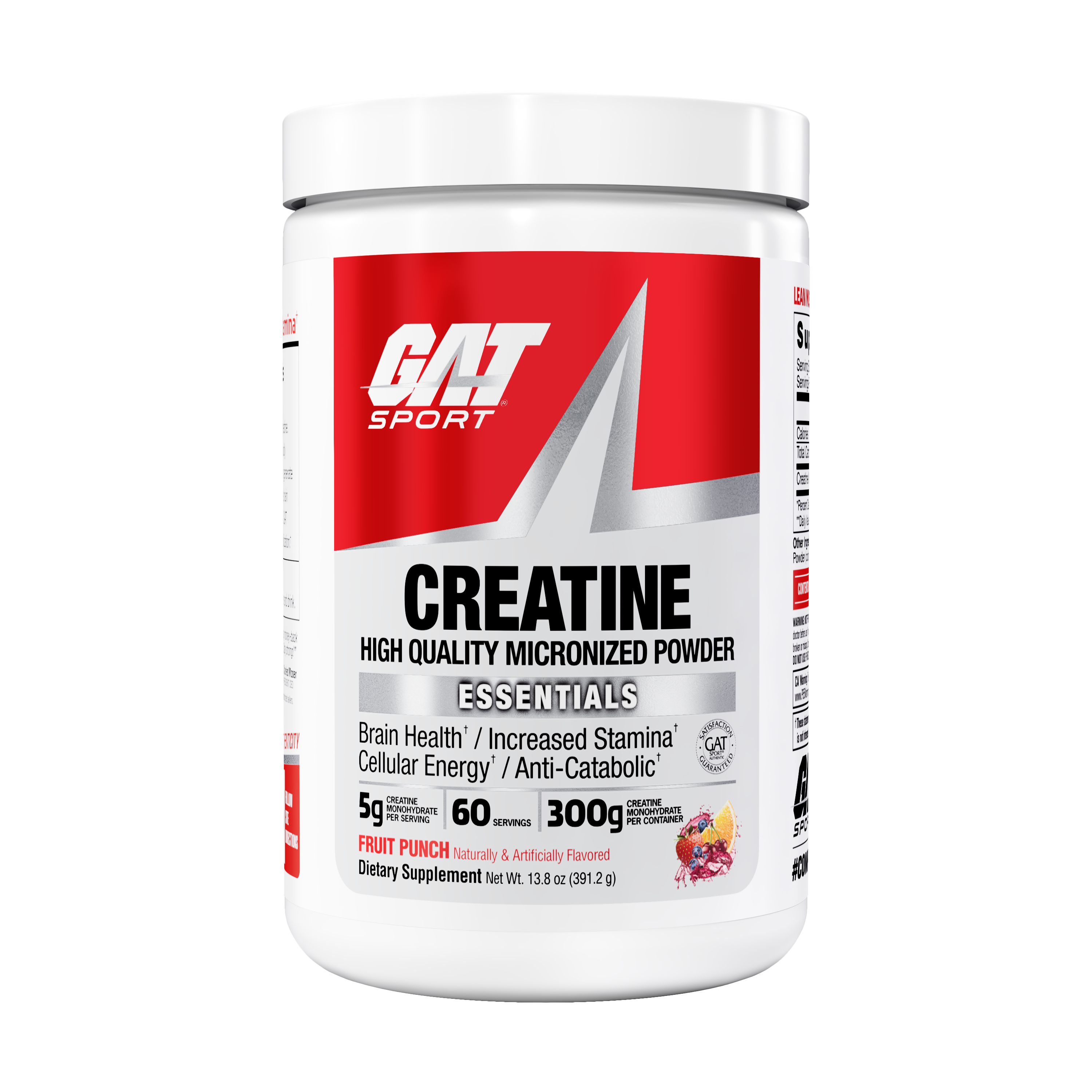
GAT Sport Creatine Monohydrate is the evidence-matched version of everything this article describes: single-ingredient creatine monohydrate, the exact form behind the research, in a dose you control. Stir it into anything you already drink daily, because the container it rides in matters far less than the streak of days it goes in. For a woman building her first creatine habit, the powder plus an existing daily anchor, the smoothie, the morning shake, is the simplest system there is.
When You Want the Habit Without the Mixing
Some routines have no shake in them, and travel weeks break even good systems. That is the job Creatine Chews were made for: a labeled serving of creatine you chew and swallow, no scoop, no shaker, no liquid, wherever the day happens. They are not a stronger form of creatine, and no one should tell you otherwise; they are the same daily habit in a format that survives busy mornings, gym bags, and carry-ons. Check the serving size on the label and count it toward your 3 to 5 grams like any other source. Powder at home, chews in motion, streak unbroken.
And on the days protein intake runs short, meetings through lunch, travel dinners, a skipped meal, a single practical backup: Flexx EAAs provide free-form essential amino acids, which stimulate muscle protein synthesis even at modest doses [6], protecting the recovery side of the ledger while the creatine habit handles performance.
Thirty Years of Research Was Never Just for Him
Strip away the marketing history and look at what the evidence actually says. Women start with lower creatine stores and eat less of it. Supplementation improves strength and performance in women who train. Through menopause and beyond, paired with resistance training, it supports the muscle and bone that matter most for how she looks, feels, and functions for decades. The bloat myth does not survive contact with the research, the bulk myth never made physiological sense, and the safety record spans thirty years.
The most researched supplement in sports nutrition was never actually a men's supplement. It was just marketed like one.
Five grams a day, every day. Start your creatine habit this week with GAT Sport Creatine Monohydrate, at gatsport.com.
Key Takeaways
- Women carry substantially lower endogenous creatine stores than men and consume less through diet, making supplementation more relevant, not less.
- Creatine improves strength and exercise performance in pre-menopausal women, and women's muscle and lower-body strength gains from training match men's.
- Through and after menopause, creatine supports muscle and combined with resistance training shows favorable effects on bone.
- The research does not support the bloating myth at daily 3-to-5-gram doses, and no amount of creatine makes anyone bulky without years of deliberate training.
- The protocol is one sentence: 3 to 5 grams of creatine monohydrate daily, every day, no loading needed, consistency over timing.
Frequently Asked Questions
Should women take creatine for strength training?
Yes. Research supports creatine for women who strength train, improving strength and exercise performance before menopause and supporting muscle, and with resistance training bone, afterward. Women also start with lower creatine stores and lower dietary intake than men, which strengthens the case for supplementing. Three to five grams of creatine monohydrate daily, taken consistently, is the evidence-backed approach for a woman lifter.
Does creatine make women bloated?
The research does not support the bloating fear at recommended doses. Creatine draws some water into the muscle cell itself, especially with high-dose loading phases, but that is intracellular water in the muscle, not puffiness under the skin, and evidence does not show ongoing whole-body water retention at 3 to 5 grams daily. Skipping the loading phase, which is unnecessary anyway, avoids the temporary scale jump entirely.
Will creatine make me bulky?
No. Muscle is built slowly by training, not by any powder, and research shows women's relative muscle gains from resistance training are similar to men's without anyone becoming accidentally bulky. Creatine simply supports more quality work in your sessions. The strong, defined look most women train for is built by exactly the kind of training creatine supports, and it takes months of deliberate effort either way.
How much creatine should a woman take daily?
Three to five grams of creatine monohydrate per day, every day, including rest days. No loading phase is needed: research shows 3 grams daily fully raises muscle creatine stores within about four weeks, reaching the same level as loading. Timing does not meaningfully matter, so attach it to something you already do daily. Stores drift back to baseline about a month after stopping, so consistency is the entire strategy.
Is creatine still worth taking after menopause?
The research suggests yes, with an important condition. Post-menopausal women may see benefits to muscle size and function with creatine, and studies show favorable effects on bone specifically when creatine is combined with resistance training. It is not a substitute for lifting; it is support for it, at exactly the life stage when preserving muscle and bone matters most for long-term strength and independence.
References
- Smith-Ryan, Abbie E., et al. "Creatine Supplementation in Women's Health: A Lifespan Perspective." Nutrients, vol. 13, no. 3, 2021, article 877, doi:10.3390/nu13030877.
- Roberts, Brandon M., et al. "Sex Differences in Resistance Training: A Systematic Review and Meta-Analysis." Journal of Strength and Conditioning Research, vol. 34, no. 5, 2020, pp. 1448-1460, doi:10.1519/JSC.0000000000003521.
- Antonio, Jose, et al. "Common Questions and Misconceptions about Creatine Supplementation: What Does the Scientific Evidence Really Show?" Journal of the International Society of Sports Nutrition, vol. 18, no. 1, 2021, article 13, doi:10.1186/s12970-021-00412-w.
- Kreider, Richard B., et al. "International Society of Sports Nutrition Position Stand: Safety and Efficacy of Creatine Supplementation in Exercise, Sport, and Medicine." Journal of the International Society of Sports Nutrition, vol. 14, 2017, article 18, doi:10.1186/s12970-017-0173-z.
- Hultman, Eric, et al. "Muscle Creatine Loading in Men." Journal of Applied Physiology, vol. 81, no. 1, 1996, pp. 232-237, doi:10.1152/jappl.1996.81.1.232.
- Ferrando, Arny A., et al. "International Society of Sports Nutrition Position Stand: Effects of Essential Amino Acid Supplementation on Exercise and Performance." Journal of the International Society of Sports Nutrition, vol. 20, no. 1, 2023, article 2263409, doi:10.1080/15502783.2023.2263409.