
The fall schedule does not negotiate. Once September hits, the open pockets of time you had all summer close up fast, squeezed by work deadlines, school runs, practices, and everything else that piles onto the calendar. In a season like this, your training setup has to be faster than your excuses. If getting ready to train takes longer than the window you have to do it, the gym loses every time.
Here is a small problem that quietly derails a lot of lifters. They want to train, they have twenty minutes, but their pre-workout lives in a tub that needs a scoop, a shaker, water, and a few minutes of prep before the session even starts. That tiny bit of hassle, multiplied across a chaotic week, becomes one more reason to skip. It sounds trivial, but small barriers are exactly what stand between intention and action when time is tight. Solving that is less about willpower and more about setting things up so training stays an easy yes.
What Is the Best Pre-Workout for a Busy Schedule?
The best pre-workout for a busy schedule is one that requires zero preparation: no scooping, no shaker, no water, and no waiting to mix. A portable, no-mix format you can take anywhere removes the friction that causes skipped sessions, so training stays a quick decision even on your busiest days. It should still deliver a real, studied dose of performance ingredients like caffeine, just in a form you can use on the move. The goal is to make starting your workout as effortless as possible.
Let me explain why that small convenience matters more than it seems, and how to build a setup around it.
Why Small Barriers Beat Big Intentions
Most people assume consistency comes down to discipline. Push harder, want it more, and you will show up. But the research on exercise behavior tells a more useful story: time pressure and convenience shape what people actually do, often more than motivation does.
Time Is the Barrier Everyone Reports
Start with the obvious one, because science backs it up. A major systematic review of the personal, social, and environmental factors influencing adults' physical activity documents perceived lack of time among the well-established barriers shaping whether people exercise [1]. In other words, the busy season is not a personal failing; it is the single most common obstacle in the entire literature on why people do or do not train. Which means any setup that shaves minutes and steps off your routine is attacking the number one enemy of consistency directly.
Convenience Quietly Drives Behavior
Now consider how sensitive behavior is to even small changes in convenience. A study of over 7,000 adults found that the greater the distance to a physical activity facility, the lower people's exercise frequency tended to be [2]. The workout itself did not change. The only difference was how much effort it took to get started, and that alone shifted how often people trained. Every extra step between you and your workout works the same way. Finding the tub, scooping, mixing, waiting: none of it is hard on its own, but each adds a little resistance, and on a packed day that resistance can tip you toward skipping.
Habits Run on Ease
This matters because your results come from showing up over and over, not from any single perfect session. Research on habit formation shows that turning exercise into an automatic, cue-triggered routine measurably improves how consistently people stay active, working independently of fragile day-to-day motivation [3]. Habits form and survive when the behavior is easy to start. The less friction between you and training, the more reliably it happens, especially in the weeks when motivation is stretched thin.
There is one more piece of good news for busy weeks: you do not need a long workout to make it count. Research on minimal-dose training shows that shorter, lower-volume sessions still produce meaningful gains in strength [4]. So, the real enemy is never the short session; it is the skipped one. A fast, friction-free setup exists to protect against skipping, which is the only thing that actually stalls progress.
Building a Friction-Free Pre-Workout Setup
The fix is to engineer your training so that starting is nearly effortless. Your pre-workout is a great place to begin, because it is often the first hurdle in the chain.
Keep a No-Mix Pre-Workout Ready
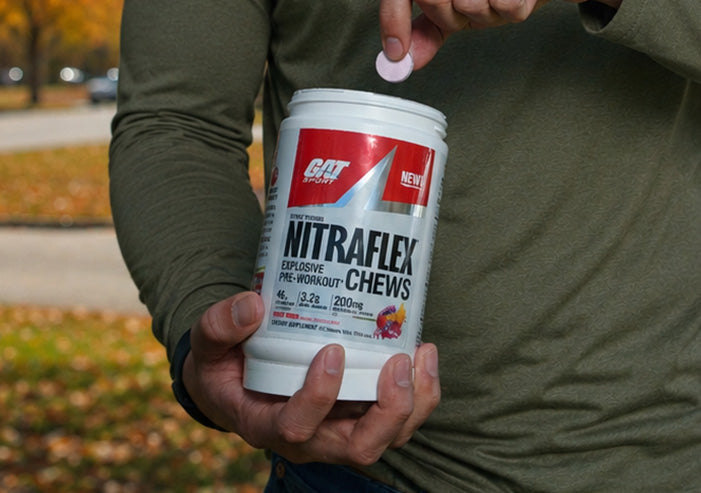
This is where Nitraflex Chews earn their place in the busy season. There is nothing to scoop, no shaker to find, no water to add, and no mixing to do. You keep them in your bag, your desk drawer, or your car, and when a training window opens, they go straight from pocket to performance. That is the whole point: the pre-workout is ready the instant you are, so it never becomes the reason you talk yourself out of a session.
The convenience does not come at the cost of what works. Caffeine is the most reliable performance ingredient in any pre-workout, and the ISSN position stand concluded that it enhances both anaerobic and aerobic performance in the range of 3 to 6 milligrams per kilogram of body weight [5]. Chews deliver that studied support in a portable form, and because you take them piece by piece, you can match your dose to the session and your own tolerance rather than committing to a fixed scoop. Quick lunchtime session? Take what you need and go.
Time It for the Session You Actually Have
A tight schedule changes timing, too. Take your pre-workout roughly 30 to 60 minutes before training so the caffeine peaks when you are working, not while you are still commuting; a grab-and-go format makes that easy to do from anywhere, no counter or sink required. And for the evening sessions that busy seasons force on many lifters, dose with your sleep in mind: research found that caffeine taken even six hours before bed significantly reduced total sleep time [6]. A pace-able format helps here as well, letting you take a smaller amount for a late session instead of committing to a full scoop that costs you the night's recovery.
Match the Tool to the Session
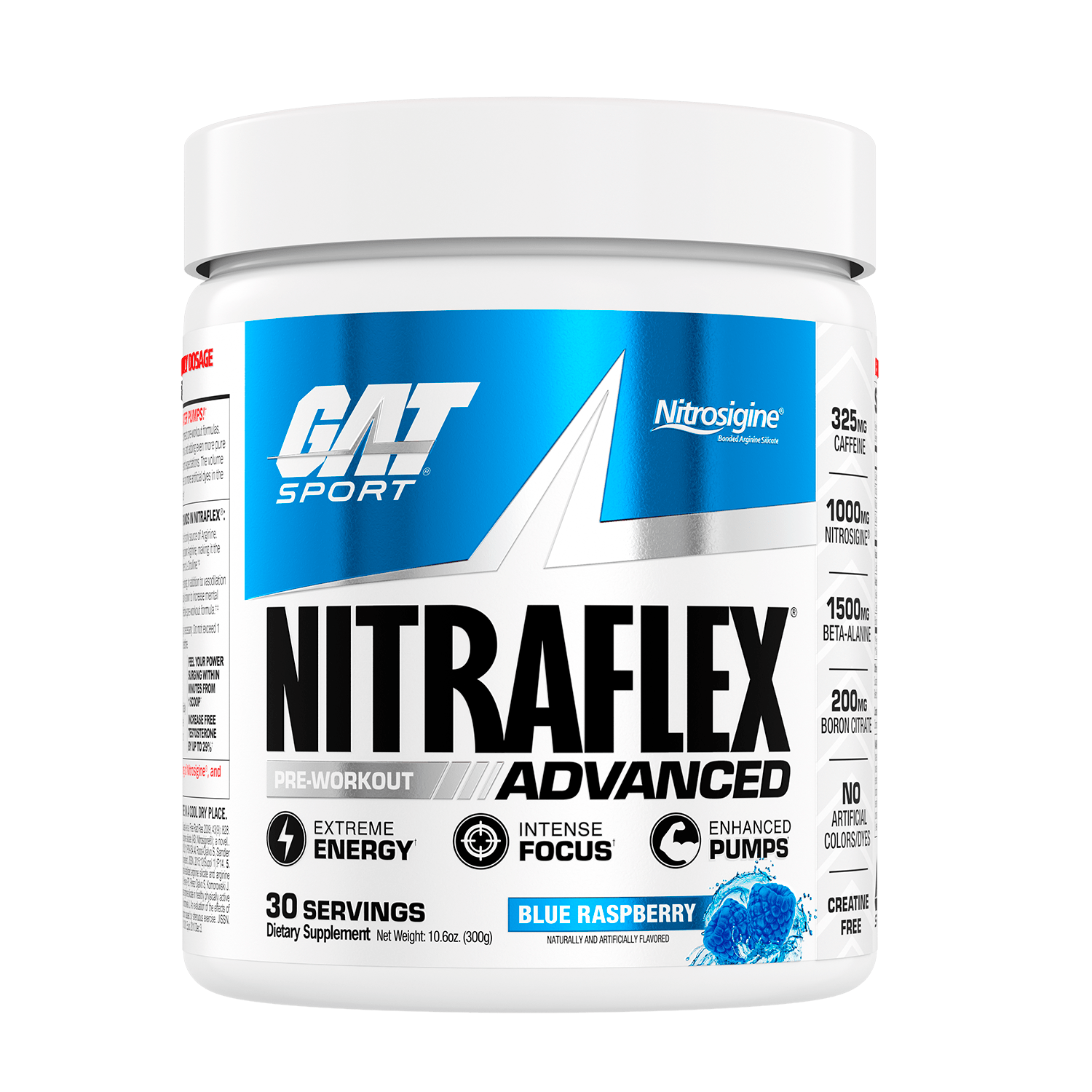
A smart setup is not one-size-fits-all. On the hurried days that define fall, when you are training between meetings or before the school pickup, the chews keep things moving. On days when you do have time, a full session at home or an unhurried weekend workout, Nitraflex Advanced gives you the complete pre-workout experience in a single scoop. The two cover the whole range of your week: Advanced for the sessions you can settle into, Chews for the ones you have to grab on the run. Keep both on hand and you are ready for whatever the schedule throws at you.
Remove the Other Small Hurdles Too
While you are at it, apply the same logic to the rest of your setup. Pack your gym bag the night before. Keep your shoes by the door. Decide in advance when and where you will train so there is no deliberating in the moment. Each hurdle you remove makes it a little more likely you follow through, and together they turn training from something you have to psych yourself up for into something that simply happens. The pre-workout is one piece, but the principle runs through your whole routine: make starting easy.
Make Training the Path of Least Resistance
The busy season punishes complicated setups. Every extra step, every bit of prep, every small hassle becomes ammunition for the part of you looking for a reason to skip. The lifters who keep training through a hectic fall are not the ones with iron discipline; they are the ones who made training so easy to start that skipping takes more effort than showing up.
Your pre-workout should work for your schedule, not against it. Keep a no-mix option ready, time it to the session you actually have, and strip the friction out of the rest of your routine. That is how progress survives the busy season: not through heroics, but through a setup that makes the right choice the easy one.
Build a friction-free pre-workout setup for the busy season. Then keep showing up, and compete harder, with GAT Sport at gatsport.com.
Key Takeaways
- Lack of time is the most commonly documented barrier to exercise, so a setup that removes steps attacks consistency's number one enemy.
- Research shows convenience drives behavior: greater distance to a gym is linked to lower exercise frequency, and every prep step works the same way.
- Consistency runs on habit and ease, and shorter workouts still deliver real strength gains, so the only true loss is the skipped session.
- A no-mix, portable pre-workout removes preparation friction while still delivering a studied caffeine dose you can pace to the session.
- Time your dose 30 to 60 minutes out, go lighter for evening sessions to protect sleep, and keep a full-scoop option for unhurried days.
Frequently Asked Questions
What is the best pre-workout for a busy schedule?
The best option is one that needs no preparation: no scooping, shaker, water, or mixing. A portable, no-mix format like a chewable pre-workout removes the friction that leads to skipped sessions, so training stays a quick decision on hectic days. It should still provide a real, studied dose of performance ingredients like caffeine, just in a form you can use anywhere, from your desk to your car to the gym floor.
Does a quick pre-workout actually work?
Yes, as long as it delivers an effective dose of proven ingredients. Caffeine is the key performance ingredient in most pre-workouts, and research supports its benefits in the range of 3 to 6 milligrams per kilogram of body weight. A portable chewable format can supply that studied dose without the prep of powder, so it works just as well while removing the hassle that causes busy people to skip.
How do you stay consistent with training on a busy schedule?
Reduce friction wherever you can. Research shows lack of time is the most commonly reported barrier to exercise and that the easier a behavior is to start, the more consistently people do it. Pack your bag ahead of time, keep a no-mix pre-workout ready, and decide in advance when and where you will train. The fewer decisions and steps between you and the gym, the more reliably you show up.
Is a short workout still worth doing?
Absolutely. Research on minimal-dose training shows that shorter, lower-volume sessions still produce meaningful strength gains. On a busy day, the choice is not between a full workout and a short one; it is between a short workout and nothing. A focused 20 to 30 minutes on the key lifts keeps your progress and momentum intact, which is far better than skipping entirely.
Can you take pre-workout for an evening session?
You can, but dose with your sleep in mind. Research found that caffeine taken even six hours before bed significantly reduced total sleep time, and sleep is where your recovery happens. For late sessions, take a smaller amount, which a pace-able format like chews makes easy, or choose a lower-stimulant option. Protecting your sleep protects the results your training is building.
References
- Trost, Stewart G., et al. "Correlates of Adults' Participation in Physical Activity: Review and Update." Medicine and Science in Sports and Exercise, vol. 34, no. 12, 2002, pp. 1996-2001, doi:10.1097/00005768-200212000-00020.
- Raza, Auriba, et al. "Distance to Sports Facilities and Low Frequency of Exercise and Obesity: A Cross-Sectional Study." BMC Public Health, vol. 22, no. 1, 2022, article 2036, doi:10.1186/s12889-022-14444-7.
- Feng, Yiyang, et al. "Effects of Habit Formation Interventions on Physical Activity Habit Strength: Meta-Analysis and Meta-Regression." International Journal of Behavioral Nutrition and Physical Activity, vol. 20, no. 1, 2023, article 109, doi:10.1186/s12966-023-01493-3.
- Nuzzo, James L., et al. "Resistance Exercise Minimal Dose Strategies for Increasing Muscle Strength in the General Population: An Overview." Sports Medicine, vol. 54, no. 5, 2024, pp. 1139-1162, doi:10.1007/s40279-024-02009-0.
- Guest, Nanci S., et al. "International Society of Sports Nutrition Position Stand: Caffeine and Exercise Performance." Journal of the International Society of Sports Nutrition, vol. 18, no. 1, 2021, article 1, doi:10.1186/s12970-020-00383-4.
- Drake, Christopher, et al. "Caffeine Effects on Sleep Taken 0, 3, or 6 Hours before Going to Bed." Journal of Clinical Sleep Medicine, vol. 9, no. 11, 2013, pp. 1195-1200, doi:10.5664/jcsm.3170.