
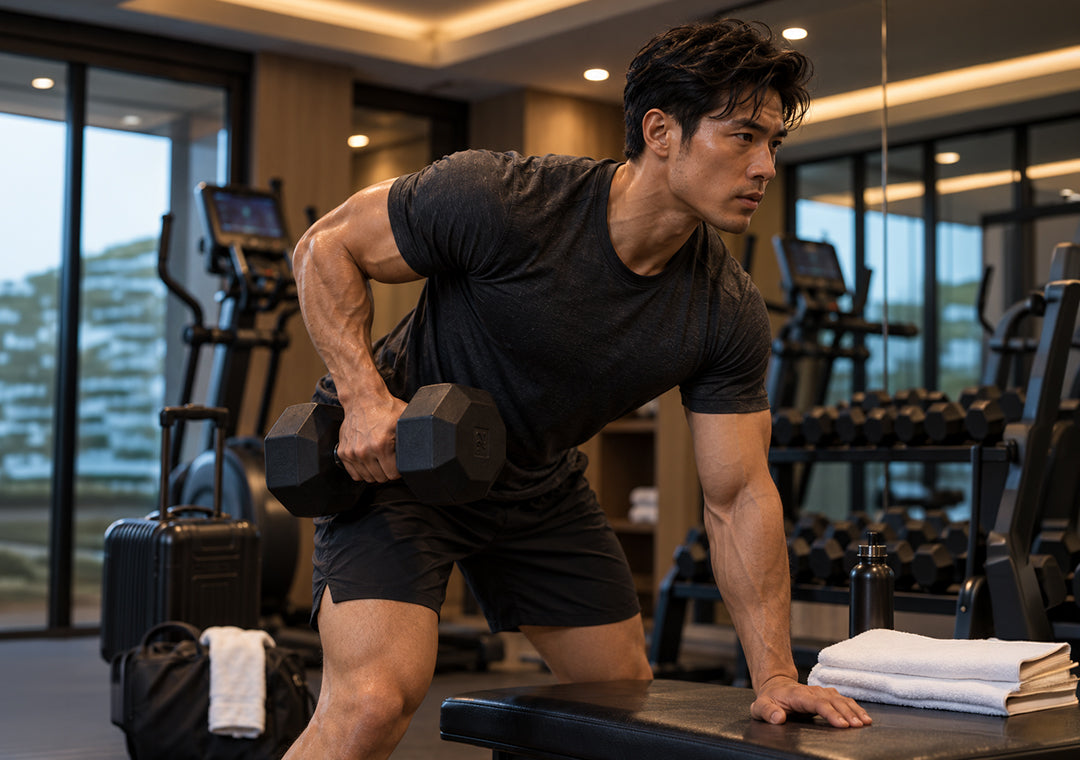
How to train while traveling doesn’t have to be challenging. Just because you are stuck with a hotel gym workout doesn’t give you a pass to sandbag your workout.
A hotel gym with a dumbbell rack that stops at 50 pounds is not a rest week. It is a different stimulus.
If you’ve been at this for any amount of time, you probably have a training program built around specific loads, exercises, and progression targets. Then you travel for work or vacation, walk into the hotel gym, and realize your normal routine is not happening.
You have two choices.
Treat the entire trip as a lost training week or adapt your training to the equipment available.
The second option is the one that makes the most sense.
You may not be able to replicate your normal squat, bench, or deadlift session. But that doesn’t mean you can’t train hard, maintain strength, and keep your routine intact while on the road.
And this is coming from someone who trained on the road for 10 years of my life in hotel gyms, and I still made great progress with my physique and health, bouncing from city to city across the US.
So, if I can do it… you can do it.
Disclaimer: This article is for informational purposes only and should not be used to treat or diagnose any condition. It is recommended that you speak with your doctor before starting any exercise program, making changes to your nutrition plan, or adding any new dietary supplements into your current regimen.
How Do You Keep Your Strength While Traveling?
You can maintain strength while traveling by training two to three times during a four- to seven-day trip, keeping your effort high, and adapting exercises to the equipment available. Use unilateral movements, controlled eccentrics, and rest-pause sets to make lighter loads challenging without needing your normal gym setup [1, 2, 3].
RELATED: Top 6 Portable Supplements for Travel
Here’s the thing: The goal isn’t to recreate your home gym. It’s to give your muscles a reason to keep adapting while you’re away.
Your Hotel Gym Workout Protocol
When you’re figuring out how to train while traveling, stop judging the workout by the weight on the dumbbells and focus on effort, movement quality, and how challenging each working set becomes.
Research suggests lighter loads can stimulate muscle growth when you take sets close to failure, though heavier loads generally help develop maximal strength. Time-efficient techniques, including rest-pause training, can also help you get more work done in less time [1].
Here is how I would recommend you approach your hotel gym workout.
Step 1: Choose the right session.
Use the lower-body, upper-body, or full-body workout outlined below based on your schedule and recovery.
Step 2: Make lighter weights challenging.
Use single-leg and single-arm exercises, slow the lowering phase (eccentric phase) to approximately three seconds, and work close to failure.
Step 3: Use rest-pause strategically.
On a safe exercise, complete your working set, rest approximately 15-20 seconds, then perform a few additional controlled reps. Use this technique selectively rather than turning every set into an absolute grind [1].
Step 4: Train two to three times during your trip.
For a four- to seven-day trip, two or three sessions are more than enough. You don’t need to force your usual training volume into every available hotel gym session.
3 Hotel Gym Workout Sessions You Can Actually Use
Complete three to four working sets per exercise, generally using 8-15 reps for dumbbell movements and a challenging, controlled rep range for bodyweight exercises.
Warm up with a few progressively harder sets before your first major movement. Rest approximately 60-120 seconds between sets to ensure you’ve recovered enough to hit another set with intensity. Again, we’re trying to get the most out of each rep and set with our hotel gym workout.
|
Session |
Dumbbell Version |
Bodyweight Version |
|
Lower Body |
Goblet squat, dumbbell Romanian deadlift, Bulgarian split squat, standing calf raise |
Tempo squat, single-leg glute bridge, reverse lunge, single-leg calf raise |
|
Upper Body |
Dumbbell floor press or bench press, one-arm dumbbell row, shoulder press, lateral raise |
Push-up, pike push-up, prone Y-T-W raises, close-grip push-up |
|
Full Body |
Dumbbell front squat, dumbbell Romanian deadlift, dumbbell floor press or bench press, dumbbell overhead press, one-arm row |
Tempo squat, reverse lunge, push-up, glute bridge, plank |
Lower Body: Make Every Rep Count
If the heaviest dumbbells available are too light for your normal squat, use Bulgarian split squats or single-leg variations.
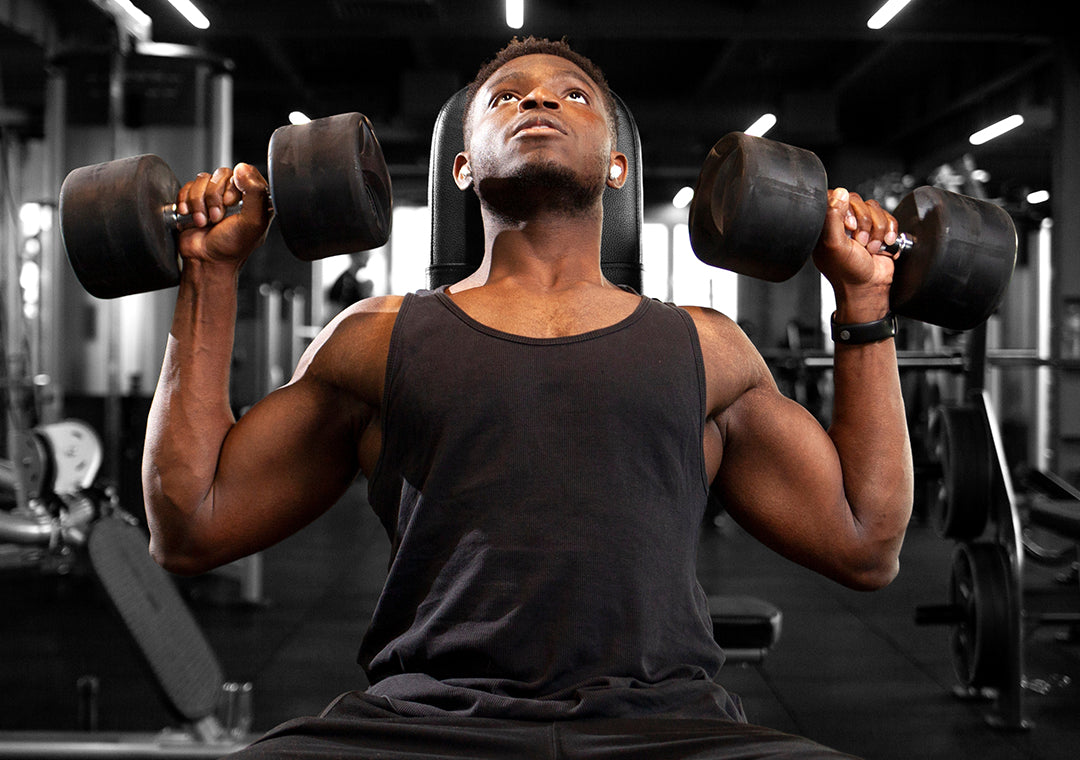
Unilateral exercises (with one foot behind you on a bench) let you challenge one limb at a time without needing to double the weight.
Slow the lowering phase, maintain a full range of motion, and avoid bouncing through your reps just to finish faster.
Upper Body: Focus on Feeling Each Contraction
You might not have access to a heavy bench press, but you can still train your chest, back, shoulders, and arms.
Use a dumbbell floor press if there is no bench to hit your chest.
Perform one-arm rows with a controlled pause at the top and really feel each contraction. If the available dumbbells are light, use slower eccentrics and work closer to failure.
Full Body: When Your Schedule Is Packed
If meetings, travel, and commitments leave you with only one training window, use the time you have available and make the most of it with a full-body hotel gym workout.
A full-body session covers the major movement patterns in one workout and makes it easier to train your entire body without needing to visit the gym every day.
You can also use supersets to save time and really stimulate each muscle. Pair exercises that use different muscle groups, such as a squat and a push-up, so you can keep moving without sacrificing exercise quality [1].
What If the Hotel Gym Is Terrible?
Been there. Done that. Honestly, it happens. A hotel is a hotel. It’s not a commercial gym, and people aren’t staying there to get in a workout. They’re staying at the hotel, so they have somewhere to sleep while on the road.
Sometimes the hotel gym is a treadmill, a yoga mat, and a couple of dumbbells that look like they belong in a preschool. Don’t use that as an excuse to skip training. Run the bodyweight version of the full-body session instead.
Perform three to four rounds of tempo squats, reverse lunges, push-ups, glute bridges, and planks. Keep the reps controlled and choose variations that make your final reps challenging without compromising technique and form.
You won’t perfectly replicate a heavy barbell session. That is fine.
Short interruptions in training won’t automatically erase all your progress. You won’t magically lose all your gains if you don’t train with heavy weights for a week. The goal here is to hit a hotel gym workout and stimulate the muscles.
Research on detraining indicates that strength losses over breaks shorter than four weeks are generally limited, although the outcome depends on the individual and the duration and nature of the training interruption [3].
Keep Creatine Consistent with GAT Sport Creatine Chews
Travel disrupts routines. Now that we’ve got the obvious out of the way, it’s no longer about excuses. It’s now about how to train while traveling and keeping things somewhat consistent.
You eat at different times, sleep in unfamiliar beds, and may not have your normal supplements from home available. That is why convenience matters.
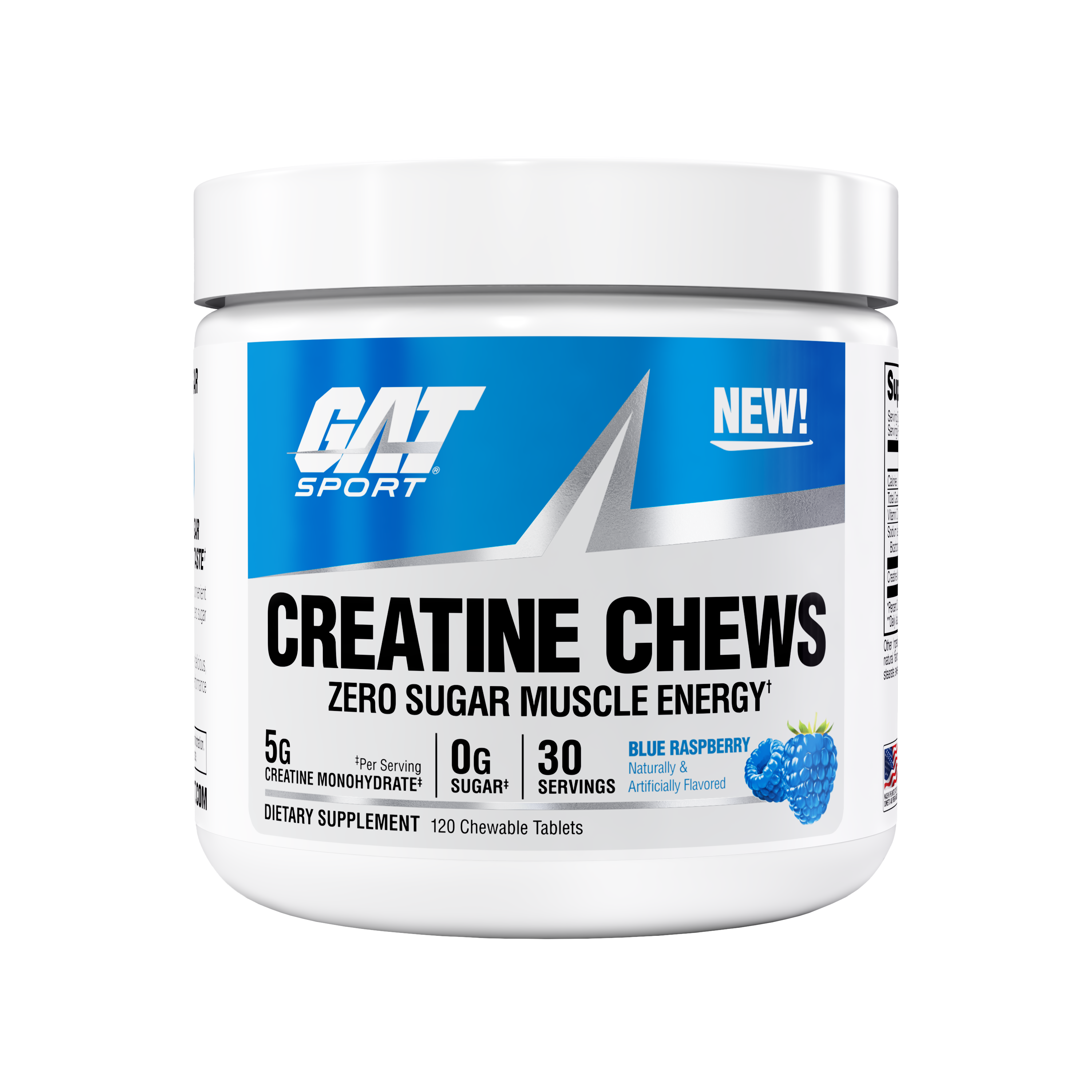
GAT Sport Creatine Chews provide 5 grams of creatine monohydrate per four-chew serving, so you can maintain your daily creatine intake without packing a tub of powder or bringing a shaker bottle along with you.
RELATED: Creatine Everyday Use Cases — Gym, Work, Travel
Creatine isn’t a stimulant, and it doesn’t replace your pre-workout. It supports high-intensity exercise performance and training adaptations through consistent supplementation. Research supports its efficacy and long-term safety in healthy individuals when used appropriately [5].
Consistency is the point to drive home here.
A study by Hultman and colleagues found that muscle creatine increased by approximately 20% following either a short loading protocol or 3 grams daily over 28 days. Muscle creatine levels gradually returned toward baseline after supplementation stopped [4].
GAT Sport Creatine Chews are the perfect option when you want creatine for travel without carrying around a messy powder.
Use Nitraflex Chews When You Need a Training Kickstart
You’ve been sitting on a plane, dealing with delays. Perhaps stuck behind the windshield for hours, and each traffic jam tests your patience. Maybe you’ve spent eight hours in meetings looking at presentation after presentation with numbers that now all look the same.
We’ve all been there. And when it’s all said and done, you find yourself staring at a hotel gym workout and trying to convince yourself to train with intensity.
This is where GAT Sport Nitraflex Chews are the ultimate solution.
Each serving provides you with 200 mg of caffeine, along with L-citrulline, beta-alanine, and L-theanine. The chewable delivery method offers a convenient pre-workout option when you don’t want to mix a powder and need to combat jet lag or travel fatigue [6].
RELATED: Why Use Nitraflex Chews Over an Energy Drink?
Don’t Ignore Hydration and Sleep
Travel can disrupt your normal hydration and sleep habits, especially when you’re flying, spending long days in meetings, or adjusting to a new time zone.
Keep it simple.
Drink fluids regularly throughout the day, bring water to your training session, and pay attention to how much you sweat. Individual fluid needs vary with sweat rate, exercise intensity, environment, and other factors, so there is no single hydration target that works for everyone [7].
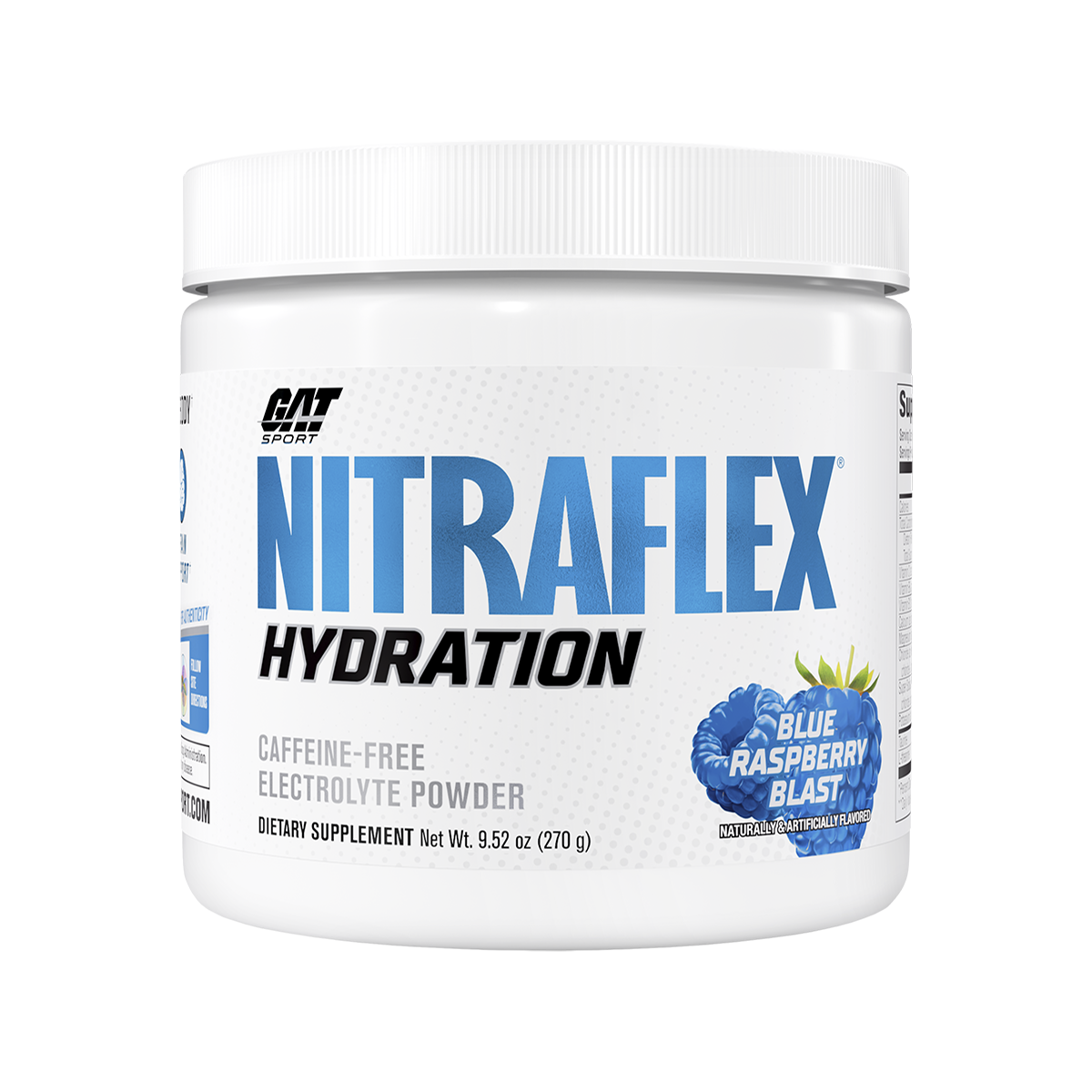
GAT Sport Nitraflex Hydration is a caffeine-free option for adding electrolytes to your water on flight days or around training.
For sleep, keep your bedtime as consistent as possible, allow enough time for recovery, and get as much sunlight as you can. Evidence on interventions for managing travel fatigue and jet lag in athletes remains limited, so avoid expecting a supplement or single strategy to erase the effects of travel [6].
At the end of the day, you can’t control every part of a travel day. You can control the basics.
Pack the plan, not the powder. Bring GAT Sport Creatine Chews and run this plan we outlined on your next trip.
Key Takeaways
- A hotel gym workout can help maintain training consistency even when the available weights are lighter than you normally use.
- Use unilateral exercises, slower eccentrics, and selective rest-pause sets to make limited equipment more challenging.
- Strive for two to three sessions during a four- to seven-day trip, adjusting for recovery and schedule.
- Short training breaks don’t automatically erase muscle and strength gains.
- GAT Sport Creatine Chews provide 5 grams of creatine monohydrate per four-chew serving, making daily creatine convenient when traveling.
- Nitraflex Chews are a pre-workout option, while creatine supports performance through consistent daily use.
- Prioritize hydration and sleep rather than expecting supplements to eliminate travel fatigue completely.
Frequently Asked Questions
How do I keep strength gains while traveling?
Train two to three times during a typical four- to seven-day trip, use challenging exercises with the equipment available, and maintain your usual effort as much as possible. Keep your daily creatine routine consistent and prioritize sleep and hydration.
Is a hotel gym workout enough to maintain muscle?
It can be. Muscle maintenance depends on training effort, weekly training volume, nutrition, and recovery. When equipment is limited, unilateral exercises and challenging sets can help you continue providing a beneficial training stimulus.
Can lighter weights build muscle?
Yes. Lighter loads can stimulate hypertrophy when sets are performed with sufficient effort and close to failure.
Should I take creatine when traveling?
You can maintain your normal daily creatine routine while traveling. GAT Sport Creatine Chews provide 5 grams of creatine monohydrate per four-chew serving, offering a convenient alternative to powder. Follow the product label.
References
- Iversen, Vegard M., et al. "No Time to Lift? Designing Time-Efficient Training Programs for Strength and Hypertrophy: A Narrative Review." Sports Medicine, vol. 51, no. 10, 2021, pp. 2079-95. https://doi.org/10.1007/s40279-021-01490-1.
- Spiering, Barry A., et al. "Maintaining Physical Performance: The Minimal Dose of Exercise Needed to Preserve Endurance and Strength over Time." Journal of Strength and Conditioning Research, vol. 35, no. 5, 2021, pp. 1449-58. https://doi.org/10.1519/JSC.0000000000003964.
- Mujika, Iñigo, and Sabino Padilla. "Detraining: Loss of Training-Induced Physiological and Performance Adaptations. Part I: Short Term Insufficient Training Stimulus." Sports Medicine, vol. 30, no. 2, 2000, pp. 79-87. https://doi.org/10.2165/00007256-200030020-00002.
- Hultman, Eric, et al. "Muscle Creatine Loading in Men." Journal of Applied Physiology, vol. 81, no. 1, 1996, pp. 232-37. https://doi.org/10.1152/jappl.1996.81.1.232.
- Kreider, Richard B., et al. "International Society of Sports Nutrition Position Stand: Safety and Efficacy of Creatine Supplementation in Exercise, Sport, and Medicine." Journal of the International Society of Sports Nutrition, vol. 14, 2017, article 18. https://doi.org/10.1186/s12970-017-0173-z.
- Janse van Rensburg, Dina C. Christa, et al. "How to Manage Travel Fatigue and Jet Lag in Athletes? A Systematic Review of Interventions." British Journal of Sports Medicine, vol. 54, no. 16, 2020, pp. 960-68. https://doi.org/10.1136/bjsports-2019-101635.
- Sawka, Michael N., et al. "American College of Sports Medicine Position Stand: Exercise and Fluid Replacement." Medicine and Science in Sports and Exercise, vol. 39, no. 2, 2007, pp. 377-90. https://doi.org/10.1249/mss.0b013e31802ca597.
Frequently asked questions
What is the main takeaway from this article?
“Training While Traveling: A Hotel Gym Protocol That Is Not a Compromise” is designed to turn practical training and nutrition guidance into clear actions you can apply to your routine.
How should I put this advice into practice?
Start with one recommendation, apply it consistently, and adjust it to your goals, training experience, and recovery needs.